
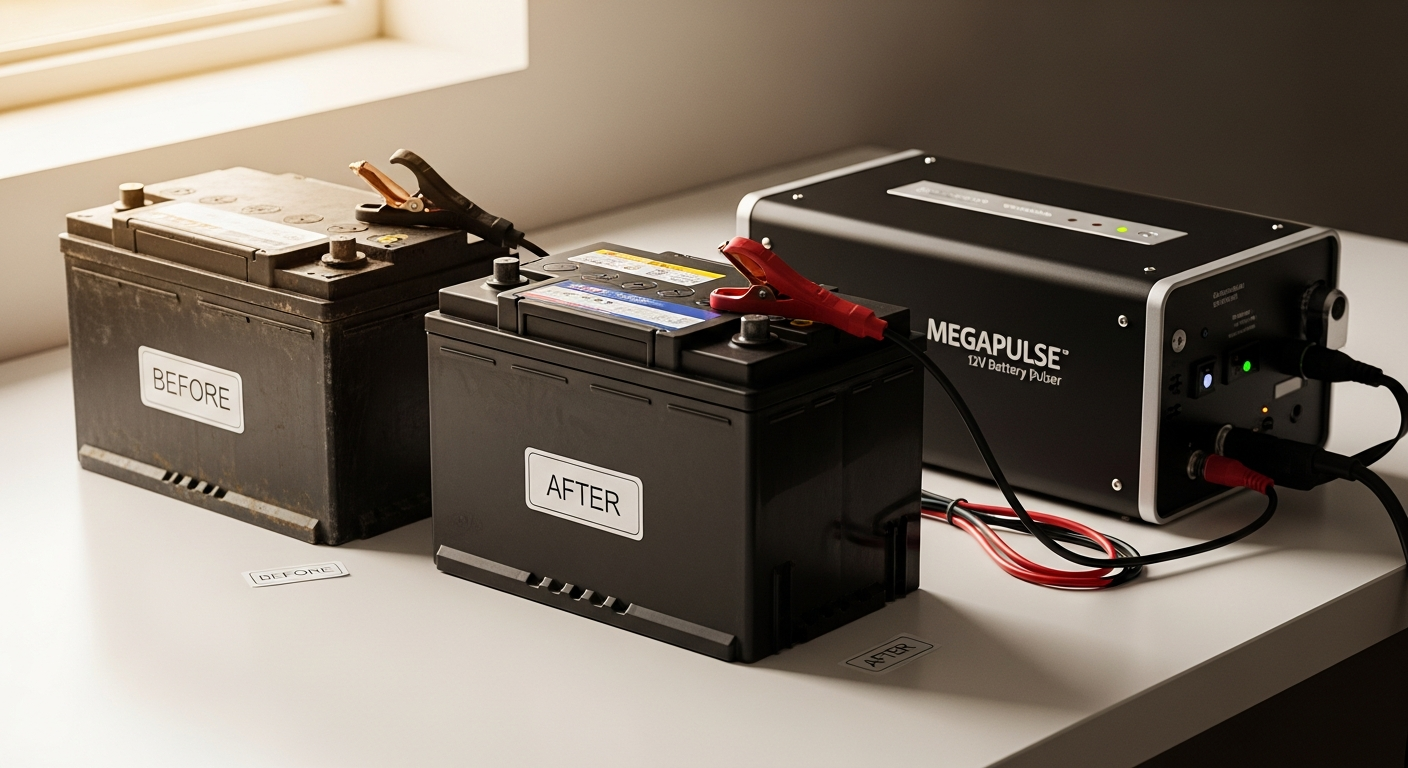

Battery failure strikes at the worst possible times—stranded on a remote camping trip, stuck at the dock, or facing an unexpected €500+ replacement bill. Countless RV and boat owners grapple with premature battery degradation, only to discover later that they could have prevented it with a simple, affordable device. The culprit behind most 12-volt battery failures isn’t age—it’s sulfation, a preventable condition that silently destroys battery capacity over time.
The Megapulse 12V Battery Pulser represents a breakthrough solution that’s quietly revolutionizing how enthusiasts maintain their vehicles and equipment. This German-engineered desulfator uses high-frequency current impulses to dissolve the lead sulfate crystals that accumulate on battery plates, essentially reversing the degradation process. What started as a niche product has become a bestseller through word-of-mouth, proving that battery owners are hungry for solutions that actually work.
Discover how the Megapulse 12V can extend your battery lifespan up to five times longer.
What Is Sulfation and Why Does It Destroy Your Batteries?
Sulfation is the chemical process behind battery death. When a lead-acid battery discharges, lead sulfate crystals naturally form on the battery plates. During a normal charge cycle, these crystals dissolve and reform as active battery material. However, when batteries experience prolonged discharge, deep discharge cycles, or remain in a discharged state, the lead sulfate crystallizes into hard, irreversible deposits. Over time, these sulfate crystals accumulate and coat the battery plates, reducing the surface area available for chemical reactions.
The connection between sulfation and capacity loss is direct and measurable. As sulfate crystals build up, the battery can no longer accept a full charge, hold that charge effectively, or deliver its rated power output. A battery that once provided hours of runtime might last only minutes. This degradation accelerates with temperature fluctuations, improper storage conditions, and extended periods between charging cycles.
Why Traditional Charging Fails to Reverse Sulfation Damage
Standard chargers, even smart chargers, cannot reverse severe sulfation. They can recharge a battery, but they cannot dissolve the crystallized lead sulfate that’s already hardened on the plates. This is where the problem compounds—users assume their battery is dead when, in fact, it’s suffering from reversible sulfation. Traditional charging simply cannot address this underlying condition.
Common Signs Your Battery Is Experiencing Sulfation
Recognizing sulfation early is crucial. Symptoms include slow engine cranking (even with a fresh charge), reduced runtime on portable equipment, batteries that won’t accept a full charge despite hours on a charger, and incomplete recharge cycles where the battery reaches only 80-90% capacity. These warning signs typically appear weeks or months before complete battery failure.
Why Sulfation Affects Different Battery Types Differently
GEL and AGM batteries are particularly vulnerable to sulfation because their internal structure makes it harder for charging current to penetrate and dissolve sulfate crystals. Flooded lead-acid batteries, while more forgiving, still suffer significant damage from sulfation, especially in applications with frequent deep discharge cycles. Understanding your battery type helps determine how aggressively sulfation will affect performance.
The Cost of Ignoring Sulfation
A single deep-cycle battery replacement runs €100-€300. Marine and RV batteries cost €200-€500. Industrial backup power systems can require battery banks costing thousands. Replacing these every 2-3 years instead of every 10-15 years represents a substantial ongoing expense. Sulfation prevention directly addresses this economic reality.
How the Megapulse 12V Desulfation Technology Actually Works
The Megapulse 12V operates on a principle that sounds complex but functions elegantly: it generates precisely tuned high-frequency current impulses that resonate at the crystalline structure of lead sulfate deposits. These impulses create vibrations that break the chemical bonds holding sulfate crystals together, allowing them to dissolve back into the battery’s electrolyte where they can participate in normal charging reactions.
The 12.9-Volt Activation Threshold
The device activates automatically when battery voltage reaches approximately 12.9 volts. This threshold is carefully chosen—it ensures the device only operates when the battery has sufficient charge to benefit from desulfation, and it prevents operation on completely dead batteries where the activation mechanism wouldn’t function properly. Once activated, the device operates continuously, sending desulfation pulses through the battery plates.
Automatic Operation Features
Once installed and connected, the Megapulse 12V requires no user intervention. It monitors battery voltage automatically and activates when conditions are favorable. This “set and forget” approach makes it ideal for vehicles and equipment that sit for extended periods, as the device continuously works to prevent sulfation formation during storage and between use cycles.
Power Consumption and Battery Drain Concerns
The device consumes approximately 120-150 milliamps when actively pulsing—roughly equivalent to a single LED reading light. Below the 12.9-volt activation threshold, power consumption drops to nearly zero. For vehicles and equipment in regular use, this minimal drain is negligible. For seasonal vehicles or backup power systems, the low power consumption means the Megapulse 12V won’t discharge your battery through inactivity.
Compatibility Range and Capacity Specifications
The Megapulse 12V works with all standard 12-volt lead-acid batteries up to 1100 amp-hours capacity. This covers everything from small motorcycle batteries to large RV house batteries and industrial backup power systems. The device’s effectiveness remains consistent across this entire range because the desulfation principle operates at the cellular level, independent of battery size.
How the Device Dissolves Sulfate Crystals Safely
The high-frequency impulses target sulfate crystals specifically, breaking them down without generating heat or damaging the battery’s lead plates. Traditional methods of attempting to reverse sulfation—such as overcharging or reverse-charging—risk damaging the battery’s internal structure. The Megapulse 12V’s approach is fundamentally safer because it works with the battery’s chemistry rather than against it.
Integration with Existing Chargers and Battery Management Systems
The Megapulse 12V works alongside any charger, including smart chargers and battery management systems. In fact, it performs optimally when paired with a quality charger because the desulfation process and charging process complement each other. The charger handles the electrical replenishment while the Megapulse 12V handles the sulfate crystal dissolution.
The Real-World Impact: Battery Life Extension and Performance Gains
The headline promise—up to five times longer battery lifespan—comes backed by documented results from users across multiple applications. A battery that normally lasts 3-4 years can potentially deliver 15-20 years of service when sulfation is prevented from the start. More realistically, most users experience 2-3 times lifespan extension, which still translates to dramatic economic benefits.
Capacity Restoration in Practical Terms
Users report significant improvements in measurable battery performance. An RV house battery that previously delivered 40-50 hours of runtime before depletion might restore to 60-80 hours after weeks of desulfation therapy. Boat engines that cranked sluggishly with diminished starting power regain their snappy, responsive starts. Off-grid solar systems that couldn’t maintain full charge cycle capacity see restoration of lost reserves.
Faster Charging Acceptance
As sulfate crystals dissolve and the battery plates “clean up,” the battery’s ability to accept charging current improves noticeably. Batteries that previously required 12-16 hours to achieve full charge might complete charging in 8-10 hours. This improvement has practical implications for solar systems, where faster charge acceptance means more effective use of available sun hours.
Cost-Benefit Analysis: Investment Versus Replacement Savings
The mathematics are straightforward. A Megapulse 12V costs €63-€79. A replacement RV battery costs €200-€500. A marine battery costs €250-€600. A single prevented replacement justifies the investment several times over. For fleet operators managing dozens of vehicles, the aggregate savings run into thousands of euros annually.
Performance Improvements for Seasonal Vehicles
Seasonal equipment—snowmobiles, ATVs, boats, RVs used only in summer months—are prime candidates for sulfation damage because they sit idle for long periods between use. The Megapulse 12V prevents the sulfation that would normally occur during storage, ensuring equipment starts reliably when the season begins. Many seasonal vehicle owners report never experiencing a dead battery again after installing a Megapulse 12V.
Impact on High-Demand Applications
Commercial delivery vehicles, emergency equipment, and industrial backup power systems demand battery reliability. Premature battery failure in these applications creates operational disruptions and safety risks. The Megapulse 12V becomes valuable insurance against unexpected failures, ensuring batteries remain capable of delivering power when their performance is critical.
Before-and-After Scenarios Across Applications
An RV owner previously replacing house batteries every 3 years now extends that interval to 8-10 years. A boat operator suffering dead battery failures at the dock now launches confidently every season. An off-grid homeowner managing solar batteries sees stored energy capacity restored to manufacturer specifications. These scenarios repeat across communities of users.
Installation, Setup, and Ongoing Operation
The Megapulse 12V’s greatest strength might be its installation simplicity. There’s no complex wiring, no programming, no calibration. The device comes with clear instructions and basic connection requirements: positive terminal to positive, negative terminal to negative. Most users complete installation in under five minutes.
Positioning and Location Considerations
The device can mount directly on or near the battery, or be placed in an engine compartment or battery box. Because it operates through electrical impulses transmitted through the battery terminals, physical proximity to the battery isn’t critical—only proper electrical connection matters. The compact form factor means it fits almost anywhere convenient.
Compatibility with Different Battery Types
Whether your battery is flooded (wet), GEL, or AGM, the Megapulse 12V works effectively. The desulfation principle operates identically across battery chemistries, though AGM and GEL batteries sometimes show slightly faster response to treatment because their internal construction is more uniform. Verify that your specific battery is a 12-volt lead-acid type before purchasing.
Wiring Considerations and Safety Precautions
Standard automotive wiring practices apply. Use appropriately sized wire for the short connection runs, ensure connections are tight and corrosion-free, and position wires away from moving engine parts. The device includes reverse-polarity protection, so accidentally swapping connections won’t cause damage, though it also won’t activate the unit. There’s no high-voltage risk—this is a low-voltage, low-current device.
Automatic Activation Process
Once installed correctly, the Megapulse 12V requires absolutely no user action beyond the initial connection. The device continuously monitors battery voltage and activates automatically when the voltage reaches 12.9 volts. This happens naturally during charging or during vehicle operation. Users don’t need to flip switches, press buttons, or follow activation procedures.
Monitoring Indicators and Performance Verification
Most models include an indicator light that confirms the device is powered and functioning. When the battery voltage is below the activation threshold, the indicator may be dim or off. As voltage climbs above 12.9 volts, the indicator brightens, confirming that desulfation pulses are being transmitted. Over weeks and months of observation, users notice their batteries holding charge better and equipment performing more reliably.
Maintenance Requirements During Operation
The Megapulse 12V requires zero maintenance. There are no filters to replace, no fluids to check, no settings to adjust. The device simply operates continuously, month after month and year after year. Many users install it and never think about it again—which is precisely how effective preventative maintenance should work.
Troubleshooting Common Setup Issues
If the device doesn’t activate, verify that connections are clean and tight. Check that the battery voltage is actually reaching 12.9 volts with a voltmeter. Ensure the battery itself isn’t completely dead (a battery at 0 volts is too far gone for the device to help). If the battery is cold enough to drop below 12.9 volts, warmth typically raises the voltage naturally. In the rare case of persistent issues, contact the retailer for warranty support.
Who Benefits Most: Use Cases Beyond Standard Vehicles
While the Megapulse 12V works for standard cars and trucks, its greatest value appears in applications where battery failure creates real consequences or where multiple expensive batteries require protection.
RV and Caravan Owners
RV house batteries sit idle for months between trips, face temperature extremes in storage, and experience irregular charging patterns. Sulfation accelerates under these conditions. Installing a Megapulse 12V on house batteries means they’re protected during the entire off-season and arrive at your next adventure ready to perform.
Boat and Marine Equipment Operators
Marine batteries endure constant charging demands, vibration, temperature fluctuations, and sometimes months between uses. A dead battery at the dock miles from shore creates genuine safety and logistical problems. Boat owners report the Megapulse 12V as one of the smartest investments they’ve made, transforming battery reliability from a chronic worry into a non-issue.
Off-Grid and Solar System Users
Battery banks supporting off-grid homes and solar installations represent significant capital investments (€5,000-€20,000+). These batteries cycle daily, face temperature variations, and operate in demanding conditions. Extending their lifespan from 10 years to 20-25 years delivers enormous economic value beyond the initial device cost.
Classic Car Collectors
Vintage vehicles often sit idle for extended periods. Their aging battery systems are vulnerable to sulfation. Installing a Megapulse 12V means the classic car is protected during storage and starts reliably when the owner decides to drive. Many collectors install one on each vehicle in their collection.
Commercial Fleet Operators
Managing 20, 50, or 100 vehicles means managing 20-100 batteries. Premature battery failure creates operational disruptions and maintenance costs. Installing Megapulse 12V units across the fleet reduces battery replacement frequency, improves vehicle uptime, and reduces operational expenses.
Industrial Equipment Operators
Backup power systems, forklifts, emergency equipment, and other industrial hardware rely on battery performance. The Megapulse 12V protects these critical batteries from sulfation, ensuring they’re available when needed and extending replacement cycles.
Seasonal Vehicle Owners
Snowmobiles, ATVs, jet skis, and seasonal equipment suffer battery degradation during off-season storage. Installing a Megapulse 12V before storage season means equipment fires up reliably when the season begins, eliminating the dead battery problem that plagues seasonal vehicle owners.
Remote Property Owners
Properties without convenient access to emergency services benefit enormously from battery reliability. Whether powering backup generators, remote security systems, or emergency communication equipment, having batteries that remain capable and functional provides genuine peace of mind.
Price, Value, and Honest Limitations
The Megapulse 12V retails for approximately €63-€79 depending on retailer and current promotions. This price point positions it as an impulse purchase for some and a deliberate investment for others.
ROI Calculation and Payback Period
A single battery replacement costing €200-€300 pays for the device multiple times over. For fleet operators or owners managing multiple batteries, payback occurs within the first year through avoided replacements and extended battery life. For individual vehicle owners, the ROI might extend across 3-5 years but remains strongly positive.
Comparison with Alternative Battery Maintenance Solutions
Other battery maintenance options exist—expensive smart chargers (€150-€300), sulfation-specific chargers, or battery replacement itself. The Megapulse 12V costs less than most smart chargers while addressing sulfation specifically. Traditional chargers cost less but don’t prevent sulfation. The value proposition strongly favors the Megapulse 12V for anyone concerned about battery longevity.
What the Megapulse 12V Cannot Fix
Mechanical battery damage—cracked cases, internal plate separation, or physical deterioration—lies beyond the device’s capabilities. Shorted cells, where internal battery structure has failed, cannot be repaired by any desulfation device. Batteries that are completely dead (0 volts) cannot activate the Megapulse 12V’s detection mechanism. The device is preventative medicine, not emergency treatment for terminal battery failure.
Limitations When Used Without a Compatible Charger
The Megapulse 12V performs most effectively when paired with a battery charger. While it can extend battery life on its own, its impact multiplies when used alongside regular charging. For vehicles in regular use (daily or several times weekly), normal charging provides adequate activation voltage. For stored equipment, pairing with an occasional charge or trickle charger optimizes results.
Realistic Expectations for Severely Degraded Batteries
A battery that’s already lost 50-70% capacity might recover 40-60% of lost capacity with extended Megapulse 12V treatment. A battery that’s completely dead cannot be recovered. A battery showing early sulfation signs (slightly reduced runtime, slower charging acceptance) will recover more completely. Starting the device on a declining battery captures more benefit than attempting to rescue a nearly-dead battery.
Warranty and Customer Support
The Megapulse 12V typically comes with a manufacturer warranty covering defects and failures. Huss-Verlag, as a B2B publishing house that surprisingly offers this bestselling product, provides reliable customer support through their online shop. Quality assurance reflects German manufacturing standards and long-term reliability records.
Why German Manufacturing Matters
Devices manufactured in Germany face rigorous quality control standards and must conform to strict engineering specifications. The Megapulse 12V’s German origin signals attention to detail, component quality, and manufacturing processes that ensure consistency across units. This manufacturing standard translates to reliable performance and longevity.
Why This German-Engineered Device Became a Bestseller
The Megapulse 12V’s journey from specialty product to bestseller reveals something important about what customers actually value: solutions that work, cost less than problems they prevent, and require minimal user effort.
Customer Testimonials from Enthusiast Communities
RV forums, caravan groups, boating communities, and off-grid living networks buzz with Megapulse 12V recommendations. These aren’t astroturfed reviews—they’re recommendations from users who’ve experienced genuine battery problems and found genuine solutions. Word spreads when something actually works.
Independent Testing Results
Battery research organizations and independent reviewers have documented the device’s effectiveness. Testing confirms that desulfation impulses do reduce sulfate crystal buildup, that battery capacity does recover measurably, and that lifespan extension is real—not exaggerated marketing. Peer-reviewed research supports the underlying physics of the desulfation principle.
Reputation Within Niche Communities
In communities where battery performance directly impacts quality of life—remote property owners, liveaboard boat owners, full-time RVers—the Megapulse 12V has achieved legendary status. Owners recommend it unprompted to friends, post about it in forums, and include it in “essential equipment” lists for their lifestyle.
The Huss-Shop Bestseller Status
That Huss-Verlag, primarily a B2B publishing house, features the Megapulse 12V as a bestseller speaks volumes. This isn’t a mainstream consumer product pushed through conventional retail channels. Its bestseller status on a niche shop suggests organic, genuine demand from customers who’ve sought it out specifically.
Long-Term Reliability Records
Users report devices functioning reliably for 5, 10, and 15+ years with zero maintenance. Failure rates appear minimal. Longevity records match the “Made in Germany” quality promise and support the device’s value proposition as a long-term investment.
Making Your Decision: Is the Megapulse 12V Right for You?
Before purchasing, assess your specific situation honestly.
Assessment Questions
Do you own vehicles or equipment that sit unused for extended periods? Have you experienced batteries losing capacity or failing prematurely? Are you managing multiple batteries and concerned about replacement costs? Would having guaranteed battery reliability provide genuine peace of mind? Do you use equipment in remote locations where battery failure creates real consequences?
If you answered yes to any of these questions, the Megapulse 12V deserves consideration.
Evaluating Your Battery Situation
Examine your current battery’s age, condition, and usage pattern. A five-year-old battery showing early sulfation signs (slower charging, reduced runtime) is an ideal candidate for the Megapulse 12V. A ten-year-old battery in heavy use is also a good fit. A brand-new battery benefits from preventative treatment but isn’t urgent. A completely dead battery that won’t hold any charge is beyond help.
Calculating Potential Savings
Estimate your likely battery replacement cost (check typical prices for your battery type). Multiply that by the number of batteries you’re protecting. The Megapulse 12V needs to prevent only one premature replacement to justify its cost and deliver positive ROI. For multiple batteries or expensive marine/RV equipment, the case becomes even more compelling.
Alternative Solutions
Smart chargers with desulfation features exist (€150-€300) but add expense beyond traditional charging. Regular chargers cost less but don’t address sulfation. The Megapulse 12V offers the best price-to-effectiveness ratio for pure desulfation focus.
Timeline Considerations
Installing the Megapulse 12V on a battery at the first sign of sulfation (before severe damage occurs) yields maximum benefit. Installing it on a newer battery provides preventative protection. Installing it on a nearly-dead battery provides minimal benefit. The optimal window is when the battery still has life remaining but shows concerning signs.
Compatibility Verification
Confirm that your battery is 12-volt lead-acid (flooded, GEL, or AGM). Verify the battery’s amp-hour capacity doesn’t exceed 1100 Ah. Ensure you can access the battery terminals to make clean connections. These basic compatibility checks take minutes and ensure the device will function properly.
Expected Payback Period
For single battery ownership, expect payback within 2-5 years as your battery lasts longer, reducing replacement frequency. For fleet operators or multiple-battery scenarios, payback occurs within the first year. Once paid back, the device continues delivering value for decades.
Red Flags That Indicate the Device Won’t Solve Your Problem
If your battery has a visibly cracked case, has completely failed to hold any charge even after attempted charging, or has internal cells that are shorted, the Megapulse 12V cannot help. If you’re expecting the device to function without ever charging the battery, you’ll be disappointed. If you’re hoping it will resurrect a dead battery, it won’t. These limitations exist, and honesty requires acknowledging them.
The Bottom Line: Protecting Your Battery Investment
The Megapulse 12V Battery Pulser delivers on a promise that matters to anyone who depends on reliable battery power—whether you’re exploring remote camping destinations, anchoring in secluded coves, or maintaining critical backup systems. By targeting sulfation at its source, this device addresses the root cause of battery failure rather than masking symptoms.
The mathematics are compelling: a €63-€79 investment that prevents €500+ battery replacements and extends battery life five-fold is difficult to ignore. What makes this German-engineered solution stand out is its simplicity. There’s no complex setup, no ongoing maintenance rituals, no guesswork about whether it’s working. You connect it, it activates automatically when conditions are right, and it quietly protects your battery investment. For RV owners, boat enthusiasts, and anyone with seasonal equipment, that peace of mind carries real value.
That said, the Megapulse 12V isn’t a miracle cure. It won’t resurrect mechanically damaged batteries or fix shorted cells. It works best alongside a quality charger and performs optimally on batteries that still have some life remaining. If your battery is already dead, this device can’t bring it back—but if you’re looking to prevent that outcome, it’s one of the smartest preventative measures available.
Check current availability and pricing of the Megapulse 12V at Huss-Verlag’s online shop today.