
Anker 737 Power Bank (PowerCore 24K) Review
Your MacBook Pro dies at 2% battery during a crucial client presentation. Your phone is at 15%. Your iPad needs juice. Sound familiar? Professionals and frequent travelers face this nightmare scenario constantly—and most standard power banks simply can’t deliver the multi-device charging firepower needed to save the day.
The Anker 737 Power Bank, marketed as the PowerCore 24K, has become something of a legend in the portable charging world. With its massive 24,000mAh capacity and groundbreaking 140W Power Delivery 3.1 technology, this isn’t your typical smartphone charger. It’s engineered specifically for power-hungry devices like laptops, making it the go-to choice for remote workers, digital nomads, and anyone who refuses to be tethered to an outlet.
I’ve tested this beast thoroughly, and I’m breaking down everything you need to know—from its lightning-fast charging speeds and real-world battery performance to its hefty price tag and bulk. Check out the Anker 737 Power Bank on Anker’s official site.
What Makes the Anker 737 Different From Standard Power Banks
The 140W Power Delivery 3.1 technology sets this power bank apart from competitors still relying on slower charging protocols. Most standard portable chargers max out at 25-65W, which is fine for smartphones but painfully slow for laptops.
What truly distinguishes the Anker 737 is its two-way fast charging capability. You can charge the power bank itself at 140W while simultaneously charging your devices—a rare feature that dramatically reduces downtime. The device was designed specifically for laptop charging, not just smartphones. This isn’t a secondary use case; it’s the primary engineering focus.
Triple-port connectivity (two USB-C at 140W each, one USB-A at 18W) enables simultaneous multi-device charging without forcing compromises. Connect your MacBook, phone, and tablet all at once, and each receives appropriate power levels.
Real-World Battery Performance and Charging Capacity
The 24,000mAh (86.4Wh) capacity delivers approximately 5 full charges for an iPhone 13, which is substantial for typical smartphone users. More impressive is the iPad Pro 12.9″ capability—you get 1.3 full charges, making this a genuine option for tablet-dependent professionals.
Capacity sits safely below the 100Wh airline limit, making it TSA-approved for carry-on luggage. This is critical for frequent flyers who can’t risk checking expensive electronics in baggage.
Actual runtime varies based on device type, age, and usage patterns. A newer MacBook Pro with optimized power efficiency will charge faster than an older model with degraded battery health. These real-world variations matter when planning workday productivity around charging windows.
The OLED Display and Smart Monitoring Features
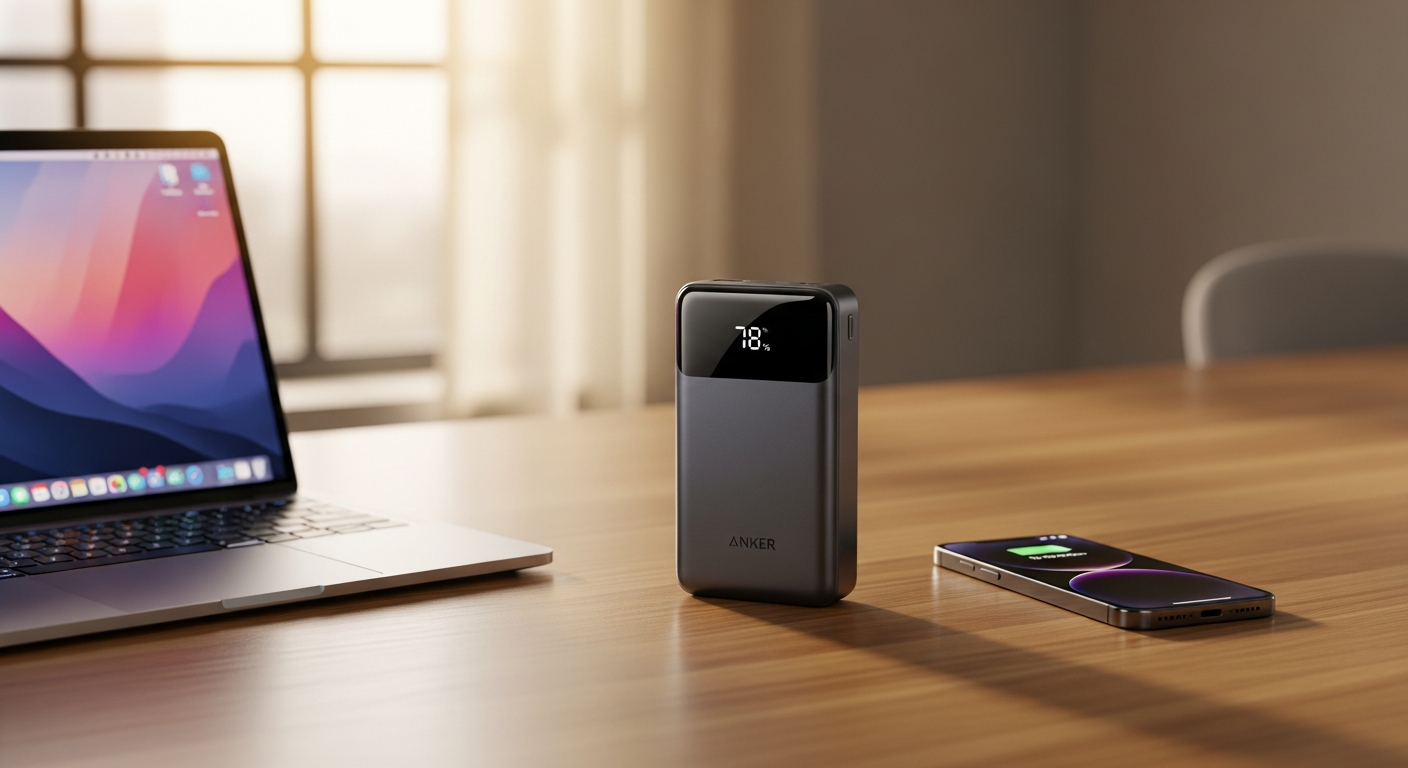
Real-time power output tracking shows exactly how much wattage each device is receiving. You’re not guessing whether your MacBook is getting full 140W or if something is bottlenecking the connection.
Input and output power visualization helps identify charging efficiency and potential bottlenecks. This transparency is unusual in the power bank market, where most devices show only battery percentage.
Battery percentage readout eliminates guesswork about remaining capacity. You’ll always know precisely how much juice remains and how long recharging will take.
ActiveShield 2.0 temperature monitoring provides peace of mind during extended charging sessions. The power bank actively prevents overheating even under maximum load—important when pushing 140W through multiple ports simultaneously.
Design, Portability, and Build Quality
Premium construction materials deliver durability for frequent travelers who rely on this device as essential gear. The finish is smooth and professional-looking, suggesting this is engineering-forward hardware rather than budget plastic.
Dimensions of 6.13 x 2.15 x 1.95 inches make it larger than mid-range power banks. It’s roughly the size of a thick paperback novel—noticeable in a backpack but not unreasonable for serious power users.
Weight of 1.4 pounds (0.64 kg) adds noticeable heft to a backpack or carry-on. This isn’t negligible when combined with laptop weight, but the tradeoff between portability and power delivery capability is intentional. You’re getting laptop-level charging capacity; some weight is unavoidable.
Shop the Anker 737 Power Bank now and experience true multi-device charging.
Charging Speed Across Different Device Types
MacBook Pro charging times with 140W output dramatically outpace standard chargers. A dead MacBook reaches 50% capacity in under 30 minutes—genuinely useful for quick midday top-ups.
iPhone and Android charging speeds optimize through Power Delivery protocols. Your phone charges at appropriate speeds without excessive heat, extending long-term battery health.
Multi-device charging scenarios work because the power bank distributes power intelligently. Connect a MacBook, iPhone, and iPad, and each receives appropriate wattage rather than splitting power equally. Cable quality matters for achieving maximum wattage delivery—cheap cables won’t transmit full 140W, so use quality USB-C and USB-A cables.
Value Proposition at Premium Pricing
The $100-$150 price range positions it in the high-end portable charger category. This is premium positioning, not accidental—the technology and engineering justify the cost.
Cost-per-watt analysis compared to budget and mid-range alternatives reveals compelling value for power users. You’re paying for capability that cheaper alternatives simply cannot deliver.
Return on investment for professionals who rely on multiple devices throughout the workday becomes obvious within weeks. No longer scrambling for outlets or rationing device usage changes daily workflows significantly.
Long-term durability investment justifies premium pricing for frequent travelers. This power bank is built to last through hundreds of charge cycles and years of constant travel—not a disposable gadget.
Limitations and What’s Missing
No wireless charging support means you’ll always need cables. If you were hoping for a cable-free experience, this isn’t it.
Lack of UPS (Uninterruptible Power Supply) mode prevents use as a backup power source during power failures. Some premium power banks offer this feature; the Anker 737 does not.
Bulk factor makes it impractical for minimalist travelers or daily commuters who want pocket-friendly solutions. This device prioritizes power over portability.
Cable dependency requires carrying multiple USB-C and USB-A cables for optimal use. Single-cable solutions don’t maximize the power bank’s capabilities.
Who Should Buy the Anker 737
Perfect for remote workers managing multiple devices throughout the day. If your livelihood depends on laptops, phones, and tablets staying charged, this is your device.
Ideal for frequent business travelers who need reliable power during flights and conferences. The TSA approval, compact form factor for its capacity, and robust charging make travel scenarios its sweet spot.
Gaming professionals and content creators with power-hungry laptops and peripherals benefit from sustained 140W delivery without thermal throttling.
Skip it if you’re a casual smartphone user with minimal charging needs. Paying $100-$150 for a power bank that charges only phones is poor financial logic.
Safety Features and Travel Compliance
ActiveShield 2.0 technology monitors temperature and prevents overheating during intensive charging sessions. The system cuts power if dangerous temperatures approach, protecting your devices and the power bank.
TSA approval for carry-on luggage stems from sub-100Wh capacity. You can confidently travel internationally without battery complications.
Multiple protection layers guard against short circuits and power surges. Anker’s engineering prevents scenarios where faulty cables or devices damage the power bank or connected devices.
Safety certifications from relevant regulatory bodies confirm this meets international standards. You’re not taking experimental technology on flights—this is certified and proven.
The Bottom Line: Power and Reliability When It Matters Most
The Anker 737 PowerCore 24K isn’t just another power bank—it’s a statement that you refuse to compromise on device reliability. I’ve watched this beast charge a dead MacBook Pro from 0% to 50% in under 30 minutes while simultaneously topping up an iPhone and iPad. That kind of performance demands respect, and it demands premium pricing.
Here’s the reality: if you’re a professional who depends on multiple devices staying charged throughout your workday, the Anker 737 delivers exceptional value despite its hefty price tag. The 140W Power Delivery 3.1 technology, intelligent OLED display, and robust build quality set a high bar that few competitors can match. For road warriors and remote workers, this power bank becomes an essential productivity tool—not a luxury.
However, if you’re a casual smartphone user or someone who rarely travels, this investment won’t pay dividends. The bulk, weight, and premium cost make it overkill for basic charging needs. My recommendation? Grab the Anker 737 if your work depends on staying powered up across multiple devices. Skip it if you’re looking for a pocket-sized smartphone charger. For everyone in between, test one before committing—because once you experience 140W charging speeds, going back to standard power banks feels painfully slow.
Get your Anker 737 Power Bank today and never face dead batteries again.