
Over 40% of smart home enthusiasts now prioritize bedroom automation, yet most settle for generic setups that lack personalization. What if your smart speaker could actually understand your environment and adapt to your needs in real time? The Echo Dot 5th Gen transforms this possibility into reality—especially when positioned as your bedroom’s intelligent nerve center.
I’ve watched how smart speakers evolved from novelty gadgets into essential home infrastructure. The Echo Dot 5th Generation represents a significant leap forward, particularly for those seeking affordable yet feature-rich voice control in intimate spaces. With its built-in temperature sensor, enhanced audio clarity, and Alexa’s sophisticated automation capabilities, this compact device punches well above its weight class and price point.
Throughout this guide, you’ll uncover exactly how to leverage the Echo Dot 5th Gen for bedroom-specific applications—from creating sleep-optimized routines to managing your personal climate, and everything in between. We’ll examine its technical specifications, explore setup strategies tailored to bedroom environments, and address whether this smart speaker truly delivers on its wellness promises.
Why Bedrooms Need Smart Speakers (Beyond Basic Music Streaming)
Voice-activated sleep routines eliminate the friction of manual app switching. Instead of reaching for your phone when you want to dim lights or set your alarm, a simple voice command handles everything. Temperature monitoring through the built-in sensor ensures your sleep environment stays optimal—crucial since core body temperature significantly influences sleep quality.
Hands-free alarm management transforms how you wake up. No more fumbling with your phone in the dark; “Alexa, set my alarm for 6 AM” works perfectly from bed. Privacy-focused voice control matters in your personal sanctuary, where conversations stay contained within Alexa’s ecosystem rather than being captured by your smartphone’s always-listening microphone.
Integration with compatible smart lights and thermostats enables ambient adjustments that sync with your natural circadian rhythm. Emergency assistance capabilities through Alexa calling provide peace of mind, especially for those living alone or with mobility considerations. Perhaps most importantly, voice-first interactions reduce screen time before sleep—a psychological benefit that supports better rest quality.
Audio Performance for Intimate Spaces: What the 5th Gen Actually Delivers
The Echo Dot 5th Gen delivers enhanced bass and vocal clarity compared to previous generations. The improved sound quality makes bedside listening genuinely pleasant for casual streaming, though realistic expectations matter here. This isn’t a bedroom speaker designed to fill large spaces or satisfy audiophiles—it’s engineered for intimate listening within arm’s reach of your bed.
Bluetooth connectivity options allow supplementary audio devices to connect wirelessly, offering flexibility if you want to upgrade your sound setup later. The removal of the 3.5mm jack from earlier models remains a point of contention. Users who wanted hardwired connections to external speakers now face limitations, though Bluetooth adapters provide functional workarounds for older audio equipment.
Performance testing across different bedroom sizes reveals consistent results: small to medium-sized bedrooms (up to 20 square meters) benefit most from this speaker’s sound profile. Streaming quality across Spotify, Amazon Music, and Apple Music remains consistent and reliable. When compared to other compact smart speakers in the €45-50 price range, the Echo Dot 5th Gen holds its own in audio reproduction while offering superior smart features through Alexa integration.
The Temperature Sensor Advantage: Creating Climate-Aware Routines
The built-in temperature sensor functions with reasonable accuracy, typically measuring room temperature within 1-2 degrees of specialized thermometers. This capability enables conditional automations that respond to actual environmental conditions rather than predetermined schedules. Imagine a routine that automatically adjusts your thermostat when bedroom temperature drops below 16°C on cold mornings—no manual intervention required.
Integration with compatible smart thermostats creates seamless climate control. Your Echo Dot reads the room temperature, triggers a routine, and coordinates with your thermostat to maintain your ideal sleep environment. Real-world scenarios include cooling routines for hot nights that activate fans or air conditioning when temperature climbs above your comfort threshold, and heating alerts that notify you of cold mornings requiring extra blankets or thermostat adjustments.
Some users report inconsistencies with temperature sensor readings, occasionally registering fluctuations that don’t match actual conditions. Troubleshooting typically involves repositioning the device away from heat sources, direct sunlight, or air vents that skew readings. Pairing with Eero mesh networks extends smart home coverage throughout your bedroom and adjacent spaces, enabling synchronized automations across multiple rooms.
Setting up temperature-triggered notifications gives you real-time awareness of bedroom conditions. A routine might send you a notification at 11 PM if temperature drops unexpectedly, allowing you to prepare for a cold night before sleep begins.
Explore the full potential of smart bedroom climate control with the Echo Dot 5th Gen today.
Gesture Control & Motion Sensing: Hands-Free Bedroom Operation
Tap gesture functionality transforms the top surface of the Echo Dot into an intuitive control interface. Tap once to play or pause music, tap twice to skip forward, and tap the sides to adjust volume—all without speaking. This capability proves invaluable during nighttime hours when you might not want to activate the microphone or prefer silent control.
Motion sensor capabilities extend beyond simple presence detection. The device recognizes directional taps and gestures, allowing you to control music, alarms, and calls through physical interaction. Reducing nighttime friction through gesture-based volume adjustment means you can lower audio gradually without reaching for your phone or using voice commands that might wake a sleeping partner.
Accessibility benefits emerge for users with mobility considerations or speech limitations. Gesture control provides an alternative interaction method that doesn’t require verbal commands or physical navigation to another device. Customizing gesture responses through the Alexa app lets you tailor the Echo Dot’s behavior to your specific bedroom needs.
Motion sensing does have limitations in larger or obstructed bedroom layouts. If your Echo Dot sits inside a nightstand drawer or behind furniture, gesture recognition suffers. Combining gestures with voice commands creates intuitive control flows—use a tap to silence an alarm, then voice your snooze request without reaching for anything.
Design & Placement Strategy for Bedroom Optimization
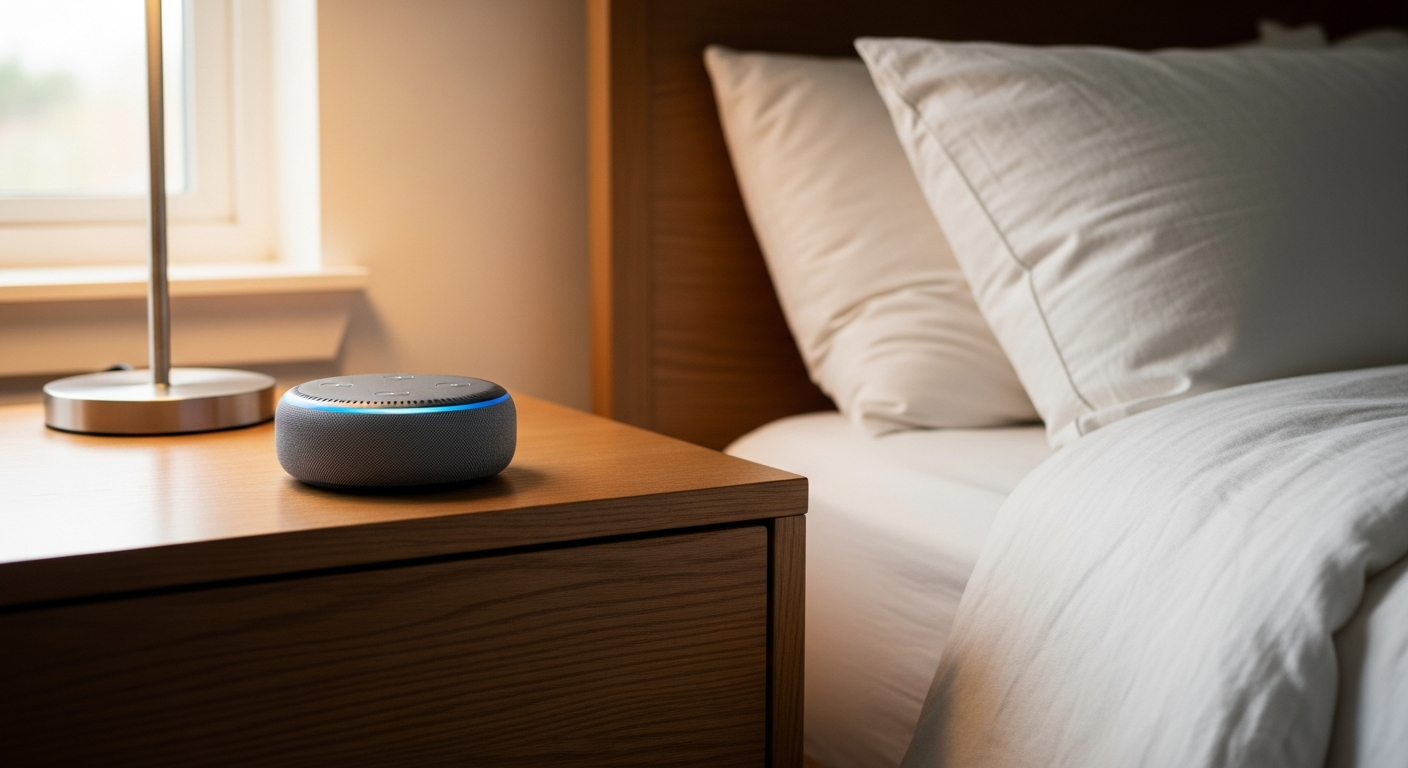
The spherical design advantages for bedside table placement shouldn’t be underestimated. The compact, rounded form factor fits naturally on nightstands without dominating the visual space. Available color options—Charcoal, Deep Sea Blue, and Glacier White—integrate aesthetically with various bedroom décors. The clock display version offers particular benefits for bedroom-specific use cases, eliminating the need for a separate bedside clock while providing time visibility without reaching for your phone.
Optimal speaker positioning maximizes microphone pickup and audio distribution. Placing the Echo Dot slightly elevated on your nightstand, approximately 30-45 cm from your pillow, ensures reliable voice command recognition while maintaining comfortable listening distance. Thermal and ventilation considerations matter for 24/7 bedroom operation. Avoid placing the device directly against walls or in enclosed spaces that restrict airflow; this prevents heat buildup that could affect long-term performance.
Cable management and power placement near sleeping areas require thoughtful planning. Route power cables along your nightstand edge or behind furniture to minimize visual clutter and prevent tripping hazards. The device measures approximately 10 x 10 x 8.9 cm, offering space-saving advantages compared to traditional nightstand clocks or standalone speakers. This compact footprint means the Echo Dot integrates seamlessly into virtually any bedroom layout without requiring dedicated furniture or extensive rearrangement.
Practical Setup: Transforming Your Echo Dot Into a Bedroom Command Center
Initial Wi-Fi configuration begins with connecting to your home network during the Alexa app setup process. The device supports dual-band 802.11ac connectivity, meaning it can connect to both 2.4 GHz and 5 GHz networks. Select the band that offers strongest signal in your bedroom—typically 5 GHz if your router sits nearby, or 2.4 GHz for longer-range coverage through walls.
Creating personalized sleep routines transforms the Echo Dot from passive device to active sleep partner. A wind-down sequence might dim smart lights, lower room temperature by 1-2 degrees, and play ambient nature sounds at gradually decreasing volume. Gradual alarm features wake you gently through progressively louder audio rather than jarring alarm sounds, easing your transition from sleep to wakefulness.
Linking compatible smart devices enables synchronized bedroom automation. Connect your smart thermostat, lights, and door locks to the same Alexa ecosystem, then create routines that coordinate all devices simultaneously. Configuring Alexa routines for morning wake-up sequences establishes a consistent rhythm: lights brighten gradually, bedroom temperature adjusts, and your favorite news briefing plays automatically.
Privacy settings specific to bedroom placement deserve careful attention. Review microphone management options to understand exactly when Alexa listens for wake words. Configure Do Not Disturb schedules that silence notifications during your sleep window. Voice training and accent recognition improve reliability for nighttime commands—spend time training Alexa to understand your unique speech patterns, which matters most when you’re groggy or speaking softly.
Troubleshooting common Alexa app frustrations during complex routine setup involves breaking down multi-step sequences into simpler components first, then combining them once each element works independently. This approach prevents configuration errors that leave you frustrated.
The Price-to-Value Reality Check: Is €45-50 Worth It for Your Bedroom?
Cost comparison against standalone smart speakers and basic alarm clocks reveals significant value. Dedicated smart speakers from other manufacturers often cost €60-80 for comparable features, while traditional alarm clocks lack any smart functionality. The Echo Dot delivers sophisticated voice control, smart home integration, and temperature sensing at roughly the price of a quality alarm clock.
Long-term value assessment requires considering smart home ecosystem expansion. If you eventually add smart lights, thermostats, or security devices, the Echo Dot serves as your central command hub, unlocking capabilities none of those devices offer independently. Hidden costs include compatible devices (smart lights typically cost €25-40 each, thermostats €100-200), subscriptions like Amazon Music Unlimited (€3.99 monthly), and potential upgrades to more powerful speakers or displays.
Budget-friendly alternative configurations using the Echo Dot maximize your investment. Start with just the speaker and a single smart light, establish reliable voice routines, then gradually expand. This approach distributes costs over time while building your confidence with voice automation. Return on investment through energy savings via smart thermostat integration can offset expenses over 18-24 months, especially if you optimize heating and cooling schedules based on occupancy and temperature readings.
Warranty and support considerations matter for bedroom-based devices that operate 24/7. Amazon provides a one-year limited warranty covering manufacturing defects, with extended protection plans available. Seasonal pricing patterns typically offer better deals during spring and autumn rather than summer months when bedroom cooling demand peaks.
Honest Limitations: When the Echo Dot 5th Gen Falls Short
Audio ceiling for users expecting robust bedroom speaker performance represents a genuine limitation. If you appreciate rich bass response and full-range audio reproduction, the Echo Dot won’t satisfy. Bass limitations mean music with prominent low-end frequencies sounds thinner than intended. Music enthusiasts seeking deeper low-end response should consider supplementary speakers or Bluetooth connectivity to external audio equipment.
Absence of the 3.5mm jack eliminates hardwired audio connections. Bluetooth speaker workarounds exist, but they require additional devices and setup complexity. Bluetooth pairing also introduces occasional connectivity interruptions that can frustrate users expecting seamless audio.
Temperature sensor inconsistencies reported by some users occasionally prevent reliable automation. When sensor readings drift noticeably from actual room temperature, conditional routines trigger incorrectly or fail to activate when needed. Microphone sensitivity challenges in certain bedroom acoustics affect voice command recognition. Rooms with hard surfaces, high ceilings, or poor insulation sometimes cause Alexa to misinterpret commands or fail to detect wake words reliably.
App complexity when programming multi-step bedroom automations frustrates users expecting intuitive interfaces. Creating conditional routines involving multiple devices and time-based triggers requires navigating nested menus and somewhat cryptic options. Wi-Fi dependency means network disruptions immediately disable voice control and smart features, leaving your bedroom temporarily disconnected from automation capabilities.
Real User Experiences: Bedroom-Focused Testimonials & Use Cases
Night shift workers optimizing sleep schedules with voice automation report transformative results. Creating multiple alarm profiles for irregular sleep hours, combined with temperature and light adjustments, helps their bodies adapt to unconventional schedules. Parents using the Echo Dot for baby monitoring and temperature tracking appreciate real-time awareness when their child’s room temperature climbs unexpectedly.
Elderly users appreciate hands-free emergency calling capabilities. Voice commands to contact family members or emergency services prove invaluable when mobility limitations make reaching phones difficult. Students leverage voice alarms and study routine management, using Alexa to maintain consistent sleep schedules despite demanding academic schedules. Couples navigating shared bedroom automation preferences discover that personalized voice profiles allow each partner to set independent alarms and routines without conflicts.
Accessibility benefits for users with mobility or vision limitations extend beyond basic convenience. Voice-controlled environment adjustments provide independence that manual controls don’t offer. Long-term reliability observations from consistent bedroom users consistently report multi-year performance without significant degradation, suggesting the Echo Dot 5th Gen withstands continuous bedroom operation.
Next Steps: Building Your Bedroom Smart Ecosystem Around Echo Dot
Compatible devices that maximize Echo Dot 5th Gen functionality include smart thermostats like the Ecobee or Nest Learning Thermostat, which integrate seamlessly with temperature-based routines. Eero mesh Wi-Fi integration extends bedroom coverage and ensures reliable connectivity throughout your space. Smart thermostat pairing for temperature-controlled sleep environments creates the foundation for climate-aware automation.
Smart lighting systems from Philips Hue or LIFX sync perfectly with Alexa routines, allowing gradual brightness adjustments during your wind-down sequences. Security camera integration provides peace of mind; voice commands let you check bedroom entry points without leaving bed. Voice profile setup personalizes your bedroom experience, enabling family members to access their own routines, alarms, and preferences.
Roadmap for expanding smart home capabilities beyond the bedroom begins with establishing rock-solid bedroom automation first. Once you master voice routines and smart device coordination in your bedroom, extending these capabilities to living areas and kitchens becomes straightforward. Your bedroom essentially becomes the proof-of-concept for your entire smart home strategy.
The Bedroom Upgrade Your Sleep Schedule Deserves
The Amazon Echo Dot 5th Gen isn’t just another smart speaker—it’s a genuinely thoughtful addition to any bedroom seeking intelligent automation without complexity or excessive cost. I’ve outlined how its temperature sensing, gesture control, and Alexa integration create a personalized sleep environment that actually responds to your needs. Yes, it has limitations; the audio won’t satisfy audiophiles, and the missing 3.5mm jack frustrates some users. But for €45-50, you’re getting a remarkably capable device that transforms your bedroom from passive space to active participant in your wellness routine.
The real magic happens when you stop thinking of the Echo Dot as a speaker and start viewing it as your bedroom’s intelligent orchestrator. Temperature fluctuations trigger climate adjustments. Voice commands replace fumbling for your phone. Routines unfold automatically, removing friction from your sleep and wake cycles. That’s where genuine value emerges—not in raw specifications, but in the daily convenience and peace of mind it delivers.
Ready to elevate your bedroom experience? Start with a single Echo Dot 5th Gen positioned on your nightstand, configure one sleep routine, and experience how voice-first automation reshapes your nightly ritual. Once you’ve experienced the difference, expanding your bedroom smart ecosystem becomes a natural next step.
Get your Amazon Echo Dot 5th Gen and start sleeping smarter tonight.