
Nearly 70% of homeowners overlook one critical design element that can completely transform a room’s aesthetic—the skirting board. Yet the right profile makes all the difference between a space that feels finished and polished versus one that appears incomplete. The Leistenhammer White MDF Hamburger Profile Skirting Board represents a breakthrough in bridging traditional German craftsmanship with contemporary interior design needs.
This isn’t just about covering the gap between floor and wall—it’s about creating an architectural detail that enhances room proportions, conceals cables, and adapts to virtually any décor scheme. The distinctive curved-to-flat transition creates a visual sophistication that works equally well in heritage properties and modern minimalist spaces. Whether you’re dealing with high ceilings that demand a pronounced statement or standard room heights requiring subtle elegance, this profile delivers.
In this guide, you’ll discover how cable channels solve real-world installation challenges, understand the dimensional options available, and learn exactly when this profile delivers maximum impact in your space.
Discover the complete Leistenhammer collection and transform your interior today.
Understanding the Hamburger Profile: Design That Bridges Eras
What defines the Hamburger profile and how its curved-to-flat transition creates visual sophistication
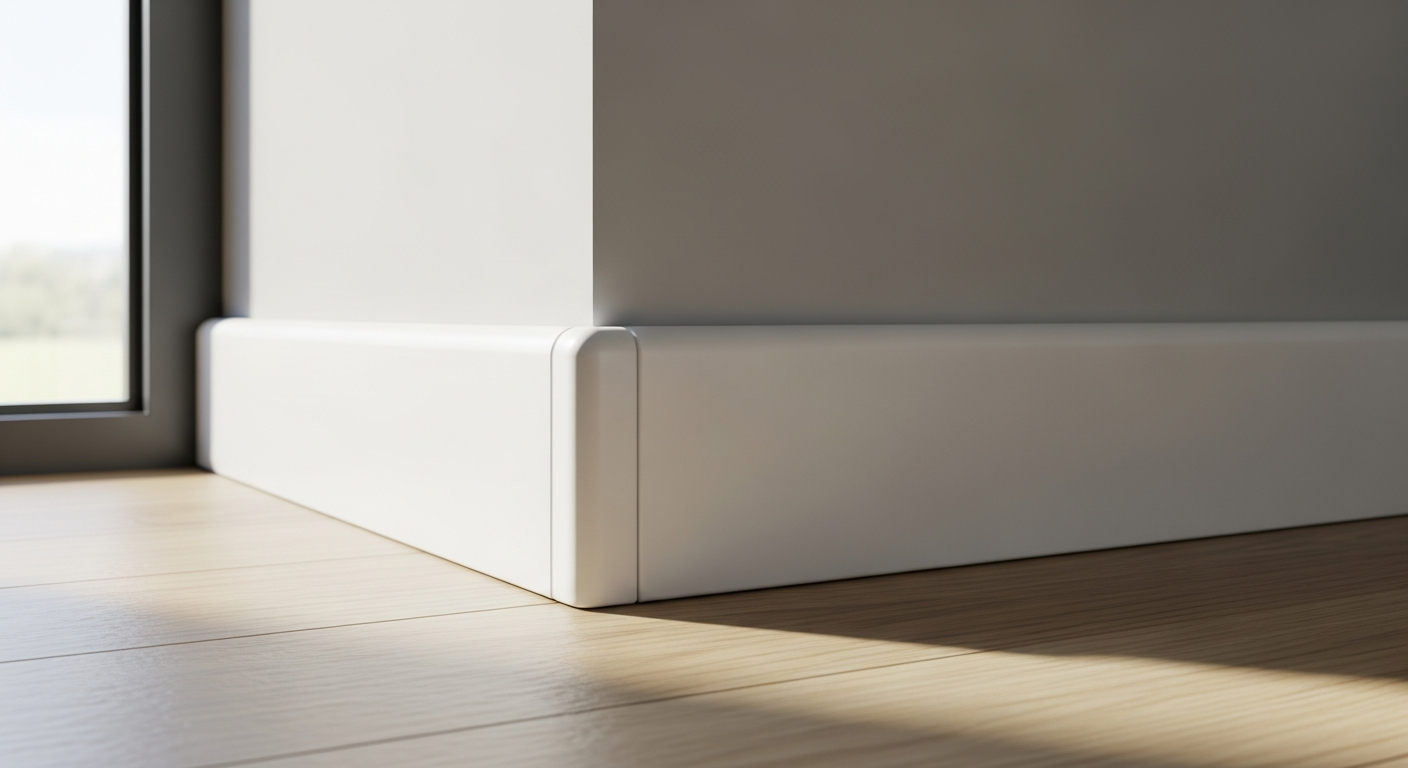
The Hamburger profile, also known as the Berliner or Altberliner profile, features a distinctly curved top edge that transitions smoothly into a flat surface. This architectural characteristic sets it apart from profiles with sharp edges or heavily ornamented designs. The gentle curve catches light differently depending on room conditions and viewing angle, creating subtle visual interest without overwhelming the space.
How the distinctive top edge complements both Altbau heritage interiors and minimalist contemporary spaces
The profile’s versatility lies in its balanced design language. In heritage Altbau apartments, the Hamburger profile respects historical proportions and aesthetic traditions while providing a clean, finished appearance. Simultaneously, its understated elegance works beautifully in contemporary settings where minimalism prevails. The curved transition avoids the stark geometry of ultra-modern profiles while maintaining enough restraint to suit modern sensibilities.
The architectural advantage of smooth transitions versus sharp-edged profiles
Sharp-edged profiles can create visual harshness and catch dust more readily. The smooth curves of the Hamburger profile reduce these practical drawbacks while offering superior visual flow. The transition from curve to flat surface guides the eye naturally along the room’s perimeter, enhancing spatial perception without demanding attention.
Why this profile has remained popular across German interior design for decades
German design philosophy prioritizes form following function without sacrificing beauty. The Hamburger profile exemplifies this principle—it performs its job effectively while maintaining timeless visual appeal. Its enduring popularity across multiple design movements demonstrates that some solutions transcend trend cycles because they’re fundamentally well-conceived.
MDF Material Science: Why This Engineered Solution Outperforms Expectations
Core composition of MDF and how density affects durability and workability
Medium Density Fiberboard consists of wood fibers compressed with resin binders under heat and pressure. The resulting material achieves a density that balances strength with workability. High-quality MDF like Leistenhammer’s formulation resists warping while remaining easy to cut and shape with standard woodworking tools. This density consistency means each board performs predictably whether you’re installing the first piece or the final corner.
Dimensional stability advantages: why MDF resists warping compared to solid wood alternatives
Solid wood responds to humidity and temperature fluctuations by expanding and contracting. This natural movement can create gaps, cracks, or warping over time. MDF’s engineered composition provides superior dimensional stability—the material doesn’t swell or shrink with seasonal changes. For homeowners, this translates to skirting boards that maintain their alignment and appearance year-round without the maintenance demands of natural wood.
Surface smoothness and its impact on paint adhesion and finish quality
The manufacturing process produces an exceptionally smooth surface that accepts paint more uniformly than solid wood grain. This smoothness allows for flawless painted finishes with minimal surface preparation. Professional painters and DIY enthusiasts appreciate how MDF skirting accepts lacquer and paint finishes without requiring extensive sanding or primer applications.
The manufacturing process that ensures consistent quality across Leistenhammer products
Leistenhammer maintains strict quality control throughout production. The MDF cores are selected for consistent density, the profiles are milled to precise specifications, and the white lacquer or foil finish is applied under controlled conditions. This manufacturing discipline ensures that whether you order 10 linear meters or 100, every piece meets the same exacting standards.
The White MDF Advantage: Specifications and Finish Quality
Standard specifications: the 19mm thickness, 80mm height, and 2500mm length breakdown
The standard Eimsbüttel model delivers practical dimensions suited to most residential applications. The 19mm thickness provides structural integrity without excessive weight, while the 80mm height creates a substantial visual presence that complements standard ceiling heights. Boards arrive in 2500mm lengths, allowing for efficient cutting and minimal waste on most wall runs.
Available height range (up to 145mm) and applications for high-ceilinged or period properties
Beyond standard heights, Leistenhammer offers options up to 145mm. Rooms with ceiling heights above 3 meters benefit from taller skirting that maintains visual proportion. Period properties and historic interiors often featured more pronounced skirting, making the extended height range essential for authentic restoration work. The variety ensures that your choice reinforces rather than fights your room’s architectural character.
RAL 9016 white standard and color consistency across batches
RAL 9016 represents a pure, slightly warm white that reflects light without appearing clinical or stark. This standard ensures consistency—whether you order boards today or in six months, the color will match perfectly. The brightness levels and undertones remain constant across production batches, eliminating the frustration of mismatched finishes in the same room.
Scratch-resistant lacquer technology and maintenance requirements
The applied lacquer finish provides genuine scratch resistance, not just a thin coating. Normal household use—vacuuming, furniture movement, occasional bumps—won’t compromise the finish. Maintenance remains straightforward: regular dusting and occasional cleaning with a damp cloth suffice for keeping the white finish pristine. The durable lacquer means you won’t need specialized products or intensive care routines.
Cable Management Reimagined: Built-In Channels for Modern Wiring Needs
How integrated cable channels eliminate surface-mounted wire clutter
Modern homes require extensive cabling for power, data, and entertainment systems. Surface-mounted cable raceways create visual clutter and architectural ugliness. The Leistenhammer Hamburger profile incorporates channels on the reverse side that accommodate standard cables. This integrated solution means electrical lines, network cables, and speaker wires route discreetly behind the skirting rather than along walls.
Capacity and compatibility with standard electrical and data cables
The channels accommodate multiple cables simultaneously—typical installations handle three to five cables without crowding. Standard power cables, Category 6 data cables, and speaker wires fit comfortably. The channel design prevents cables from pinching or crushing while maintaining accessibility if future modifications become necessary.
Installation techniques for routing cables discreetly behind the profile
Installation begins before the skirting boards attach to walls. Route cables through the channels, then secure the board in place. Strategic drilling at corners and wall outlets allows cables to transition from behind the skirting to their final destinations. Careful planning of cable routes during installation prevents future frustration and maintains the clean aesthetic throughout your space.
Safety considerations and proper cable management practices
Proper cable management ensures safety and functionality. High-voltage power cables shouldn’t run immediately adjacent to data cables—maintaining separation reduces potential interference. Cables require adequate ventilation within the channels to prevent heat buildup. When planning your installation, consider consulting with an electrician if your wiring involves significant amperage or complex layouts.
Visit Leistenhammer.de to explore cable-integrated skirting solutions for your next project.
Installation Advantages: Why DIY and Professionals Alike Prefer MDF
Workability: cutting, shaping, and joining MDF with standard tools
MDF responds beautifully to standard woodworking tools. A quality miter saw produces clean 45-degree cuts for corner joints. Circular saws handle straight cuts effortlessly. Hand tools work equally well—chisels, planes, and sanders all engage MDF predictably. You don’t need specialized equipment or professional-grade machinery to achieve quality results. This accessibility makes MDF the material of choice for both DIY enthusiasts and professional installers.
Lightweight characteristics that simplify handling and positioning
Compared to solid hardwood skirting of equivalent dimensions, MDF boards weigh considerably less. Single individuals can position and align boards without assistance, and installation moves forward more quickly. For second-story installations or work in tight spaces, this weight advantage becomes genuinely significant. Moving boards up narrow staircases or maneuvering around existing fixtures becomes manageable solo.
Adhesive and fastening options suitable for various wall types
MDF accepts multiple fastening approaches depending on your substrate. Masonry walls accommodate concrete anchors, plasterboard walls work with standard drywall fasteners, and timber-framed walls accept traditional nailing. Quality construction adhesive bonds MDF securely to nearly any wall surface, often used in combination with mechanical fasteners. This flexibility allows installers to adapt methods to specific site conditions.
Mitering and corner solutions for seamless transitions
Internal and external corners require precise mitering. MDF’s workability allows for clean cuts that produce tight joints. Unlike some materials that splinter or chip at corners, MDF miter joints remain stable and paint seamlessly. Coping saws and power tools both work well for creating custom corner solutions when standard right-angle miters don’t suit your layout.
The Smart Choice for Discerning Interiors
The Leistenhammer White MDF Hamburger Profile Skirting Board delivers far more than aesthetic refinement—it represents a practical solution that respects both your design vision and your installation timeline. Whether you’re restoring a historic Berlin apartment or creating a sleek modern interior, this profile adapts beautifully. The integrated cable channels solve genuine problems in contemporary homes, the MDF material works with your tools and schedule, and the price point makes quality accessible without compromise.
From understanding RAL 9016 white finishes to calculating your linear meter requirements, you now possess the knowledge to make an informed decision. The dimensional stability protects your investment across seasons, the durable lacquer finish resists the everyday wear that damages lesser products, and the distinctive Hamburger profile ensures your rooms feel genuinely finished rather than merely functional.
Consider how skirting boards frame your space at eye level throughout daily life. The right profile influences your perception of room proportions, influences light reflection, and either contributes to or detracts from your overall interior vision. The Leistenhammer solution eliminates compromise—you gain traditional aesthetic appeal without sacrificing modern functionality, all at a price point that makes premium quality genuinely accessible.