
Outdated tile plinths are silently aging your entire interior—and most homeowners assume complete tile removal is their only option. The truth? You can refresh your space in a single afternoon without breaking a wall or your budget. Leistenhammer, a German manufacturer with decades of skirting board expertise, has engineered a practical solution that’s gaining serious traction among both DIY renovators and professional contractors.
The Leistenhammer Fliesensockel Abdeckleiste in RAL 9016 (bright white) isn’t just another cover strip—it’s a straightforward answer for anyone tired of looking at worn tile baseboards. This guide walks you through everything you need to know: what makes this MDF cover strip stand out, how installation actually works, real-world pricing and value, and whether it’s the right fit for your renovation goals.
Discover the Leistenhammer Fliesensockel Abdeckleiste RAL 9016 today and transform your space.
Why Tile Plinths Become a Design Problem (And Why Most Solutions Feel Overwhelming)
How outdated tile baseboards date an entire room’s aesthetic
A room’s foundation matters more than most people realize. Your eye naturally gravitates toward the transition between wall and floor, and when that transition features worn, discolored, or simply dated tile plinths, it undermines even the most thoughtfully decorated space. A living room with fresh paint, new furniture, and modern fixtures can still feel tired if the baseboards scream “2005.” This visual disconnect is impossible to ignore once you notice it—which most homeowners do, usually while scrolling through interior design inspiration and realizing their own space feels stuck in time.
The emotional burden of planning a full tile removal project
Consider what a complete tile plinth renovation traditionally involves: weeks of planning, multiple contractor quotes, dust covering everything you own, noise disrupting your household routine, and the constant anxiety of unexpected structural issues. Many homeowners approach this prospect with genuine dread. The financial uncertainty alone—”Will they find mold? Will the wall need repair?”—creates decision paralysis. For renters or those without significant renovation budgets, a full tile removal project feels impossibly out of reach.
Why traditional re-tiling creates dust, mess, and extended timelines
Jackhammering out old tile plinths generates the kind of dust that penetrates every corner of your home for weeks. The noise alone drives families temporarily out of their houses. Disposal costs add up quickly. Then comes the actual re-tiling work—grouting, curing time, potential wall preparation—stretching a simple aesthetic fix into a multi-week ordeal. Professional labor costs for this work typically run into hundreds of euros, making the entire project feel like a luxury rather than a practical update.
Common frustrations homeowners face when considering plinth renovation
The central frustration is this: outdated plinths genuinely bother you, yet every “solution” feels disproportionately complicated and expensive. You’re caught between accepting an aesthetic you dislike or committing to a full renovation you’re not sure you can afford or tolerate. This tension keeps countless interiors looking dated simply because the perceived barrier to change feels insurmountable.
MDF Construction and RAL 9016 Finish: What You’re Actually Getting
MDF core composition and why it outperforms solid wood for this application
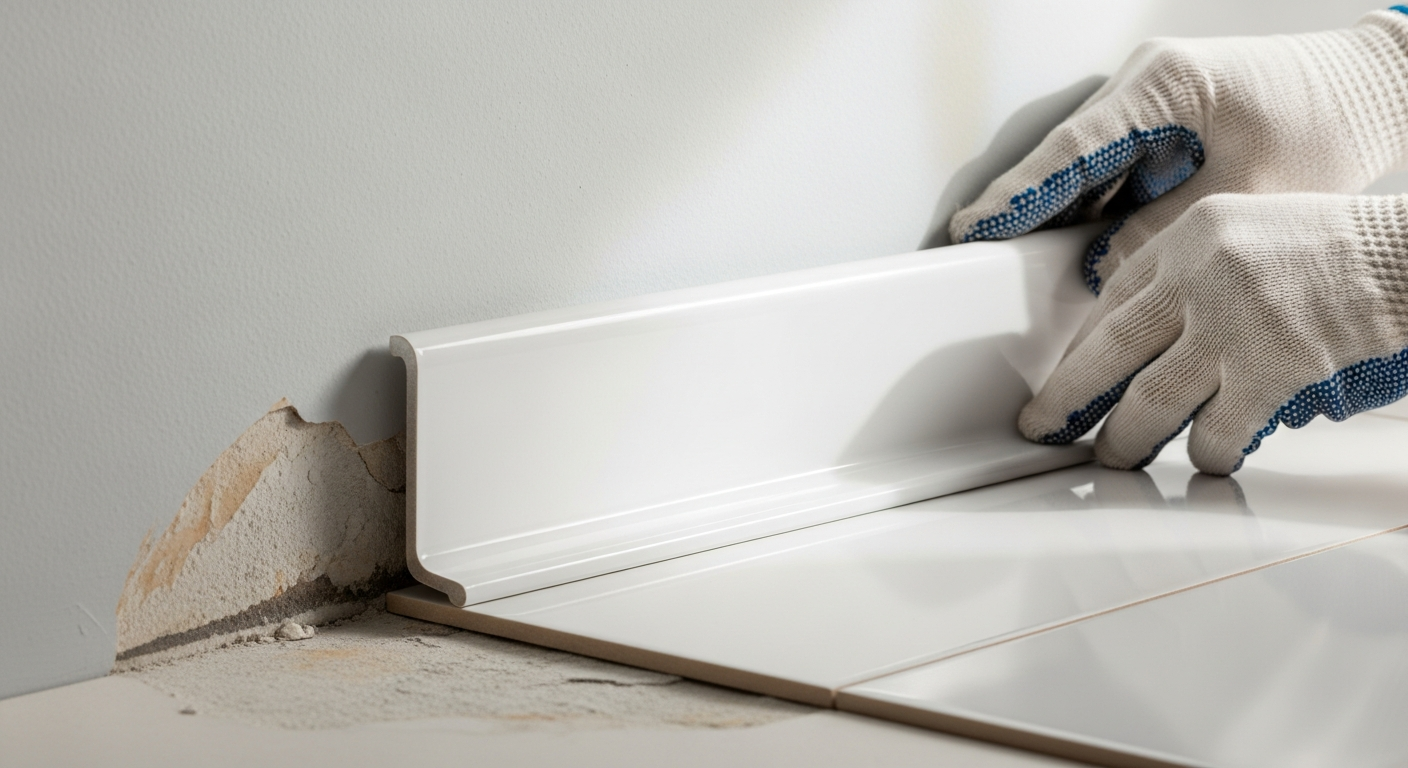
The Leistenhammer Fliesensockel Abdeckleiste uses medium-density fiberboard (MDF) as its core material—a choice that might surprise those expecting solid wood. MDF actually outperforms solid wood for plinth cover strips because it resists warping and swelling, which matter enormously in the variable moisture environment near tile plinths. Solid wood can warp from humidity fluctuations, potentially creating visible gaps or uneven surfaces. MDF’s engineered composition distributes moisture evenly, maintaining its shape year after year. For an application where consistent, smooth coverage matters more than the aesthetic of natural wood grain, MDF is the superior choice.
Dimensional stability benefits and resistance to warping
Year-round temperature and humidity variations don’t faze MDF the way they do natural wood. This means your Leistenhammer cover strip will sit flush against your tile plinth in July and January alike. No movement, no gaps, no creeping inconsistencies. This stability is foundational to the product’s durability—one reason Leistenhammer confidently backs their skirting boards with a 10-year guarantee. The dimensional stability extends the product’s useful life significantly, making it a genuinely economical choice despite the material being engineered rather than solid.
RAL 9016 color specification and its versatility across interior styles
RAL 9016 designates a specific bright white tone—standardized, consistent, and professional. This isn’t an off-white or cream shade that might clash with either warm or cool interiors. Bright white adapts effortlessly across Scandinavian minimalism, contemporary industrial spaces, traditional interiors, and virtually everything between. The color recedes visually, allowing your actual décor to command attention. A white plinth also reflects light subtly, which can make rooms feel slightly more spacious than darker alternatives.
High-quality foil finish durability and scratch resistance
The covering isn’t paint or stain—it’s a protective foil layer applied to the MDF. This distinction matters practically: foils resist scratching better than paint, don’t require refinishing every few years, and maintain their finish even with regular contact (vacuum cleaners bump baseboards; it’s unavoidable). The foil also resists moisture more effectively than painted surfaces, important given the plinth’s proximity to tile and occasional floor cleaning splash-back. This durability directly connects to the 10-year guarantee Leistenhammer offers.
Get the Leistenhammer Fliesensockel Abdeckleiste RAL 9016 and experience German quality firsthand.
Installation Methods That Don’t Require a Contractor
Glue-down application process and drying times
The simplest installation method uses construction adhesive formulated for MDF and tile. You apply the adhesive to the back of the cover strip in a serpentine pattern, press it firmly against your existing tile plinth, and let it cure. Drying typically takes 24 hours before the adhesive reaches full strength. This method requires virtually no tools beyond the adhesive itself and a clamping system (you can use painter’s tape or temporary bracing) while it dries. It’s the approach most suited to quick renovations where you want minimal wall impact.
Screw fastening for maximum hold on various wall types
For maximum security—particularly on concrete or very solid walls—screwing the cover strip provides permanent, adjustable fastening. You pre-drill holes to prevent MDF splitting, then use stainless steel screws (which resist corrosion better than standard fasteners). This method works excellently when you want the ability to remove or adjust the cover strip later. Screw heads are typically counterbored and then filled with matching plugs for a seamless appearance. The installation takes slightly longer than gluing but gives you more control over alignment and spacing.
Nailing techniques for seamless integration
Finishing nails work well on drywall surfaces supporting your tile plinth. You’ll want a nail gun or finish hammer and stainless steel nails to prevent rust staining over time. Nail spacing matters—typically every 30-40 centimeters along the length maintains even support. This method is fast and reversible (nails can be removed without wall damage), making it popular among renters. The final step involves countersinking nails slightly and filling with matching wood filler for an invisible result.
Step-by-step preparation of existing tile plinths
Before any installation method, your existing tile plinth needs basic preparation. First, thoroughly clean the surface to remove dust, debris, and any loose material. A damp cloth followed by complete drying prevents adhesion issues. Inspect the tile for loose sections and re-grout or secure any movement areas—you want a solid, stable base. Check that your plinth surface is reasonably flat; significant concavity or convexity requires attention before you install the cover strip. Finally, measure the linear footage accurately and account for corners (inside and outside) when ordering your materials.
Pricing Breakdown and Cost-Benefit Analysis
Approximate €17.22 per 2.5-meter unit and per-meter calculations
The Leistenhammer Fliesensockel Abdeckleiste (Dahlewitz model, 19x96mm) costs approximately €17.22 per 2.5-meter unit. This breaks down to roughly €6.89 per running meter—remarkably economical for a quality product. A typical room with, say, 15 linear meters of tile plinths requires six units, bringing material costs to approximately €103. This pricing accounts only for the cover strips themselves, not adhesive, fasteners, or corner pieces, which add minimal additional cost.
Total project cost estimation for average room dimensions
A standard bedroom with 20 linear meters of plinths costs roughly €138 in materials. Adding adhesive, nails, wood filler, and corner components brings total material cost to perhaps €160-180. If you’re installing yourself, labor cost is zero. Compare this to professional tile removal and re-tiling estimates, which typically start at €600-800 for equivalent square footage. Even accounting for professional installation of the cover strip (roughly €200-300 labor), your total cost remains dramatically below traditional renovation approaches.
Comparison with traditional tile removal and re-tiling expenses
Traditional tile removal requires jackhammering, wall repair assessment, new tile purchase, adhesive, grout, professional installation, and cleanup—easily running €1,500-2,500 for a modest room. This assumes no structural issues requiring wall repair, which frequently increases costs further. Timeline extends to several weeks with significant household disruption. The Leistenhammer solution delivers a comparable visual result—fresh, clean plinths—at roughly one-tenth the cost and with an afternoon’s installation time.
Labor savings when choosing DIY installation
The most compelling financial advantage comes from DIY installation. If you possess basic tool competency, you can install cover strips yourself, eliminating contractor labor entirely. The time investment is minimal—perhaps an hour per 30 linear meters—making a weekend project entirely realistic. This labor savings represents the difference between a €200-300 professional installation cost and zero, making the overall project budget genuinely accessible.
Real Customer Experiences and Satisfaction Ratings
Top-rated status on Leistenhammer’s official platform
The Fliesensockel Abdeckleiste consistently achieves top-rated status on Leistenhammer’s website, indicating both popularity and satisfaction. This isn’t just positive feedback—it’s sustained positive feedback across numerous customer purchases. Products don’t maintain top-rated status by delivering mixed results; they reach and sustain that position through reliable performance across diverse user expectations.
Recurring praise for quality and durability
Customer reviews repeatedly highlight the quality of materials and finishes. Buyers note that the foil coating maintains its appearance despite regular use, and the MDF core shows no signs of swelling or warping even years after installation. The dimensional stability that engineering theory suggests actually delivers in practice—something customers appreciate by noting the absence of gaps or movement. Durability praise connects directly to the 10-year guarantee; customers recognize that Leistenhammer’s confidence in their product is justified.
Quick delivery timelines and customer service responsiveness
Beyond product quality, customers praise Leistenhammer’s logistics and customer service. Orders arrive quickly, reducing project timelines. Customer service responds promptly to questions about specifications or installation. This operational efficiency matters to people who commit a weekend to a renovation—delays frustrate, and responsiveness impresses.
Before-and-after transformations from verified buyers
Verified customer reviews frequently include descriptions of dramatic visual transformations. A kitchen that felt dated suddenly appears updated simply through plinth cover replacement. A bathroom that looked tired gains a contemporary feel. These transformations matter psychologically—they demonstrate that the solution actually delivers the aesthetic improvement homeowners sought. Real results from real customers create confidence far more effectively than marketing claims.
Your Path Forward: Making the Smart Plinth Decision
Tired tile plinths don’t have to trigger a major renovation panic. The Leistenhammer Fliesensockel Abdeckleiste RAL 9016 genuinely delivers on its promise: affordable, fast, and visually satisfying plinth coverage that transforms tired interiors without the demolition drama. The MDF construction with its 10-year guarantee proves Leistenhammer stands behind their product. The bright white RAL 9016 finish adapts seamlessly across design styles, and the paintable surface gives you creative freedom down the road.
Whether you’re a DIY enthusiast tackling a weekend project or a professional looking for reliable cover strip solutions, the combination of German quality, reasonable pricing (around €17.22 per unit), and straightforward installation makes this a compelling choice. Your next step is practical: measure your existing tile plinths, calculate the linear footage you’ll need, and source your Leistenhammer cover strips from a trusted supplier. Spend an afternoon installing, step back, and enjoy a room that looks intentionally designed rather than outdated.