
Ceiling height limitations affect more than half of home gym builders. If you’ve felt caught between wanting professional-grade cable training and the reality of your basement or low-ceilinged workout space, you’re not alone. The vertical constraint has prevented countless fitness enthusiasts from building the complete home gym of their dreams.
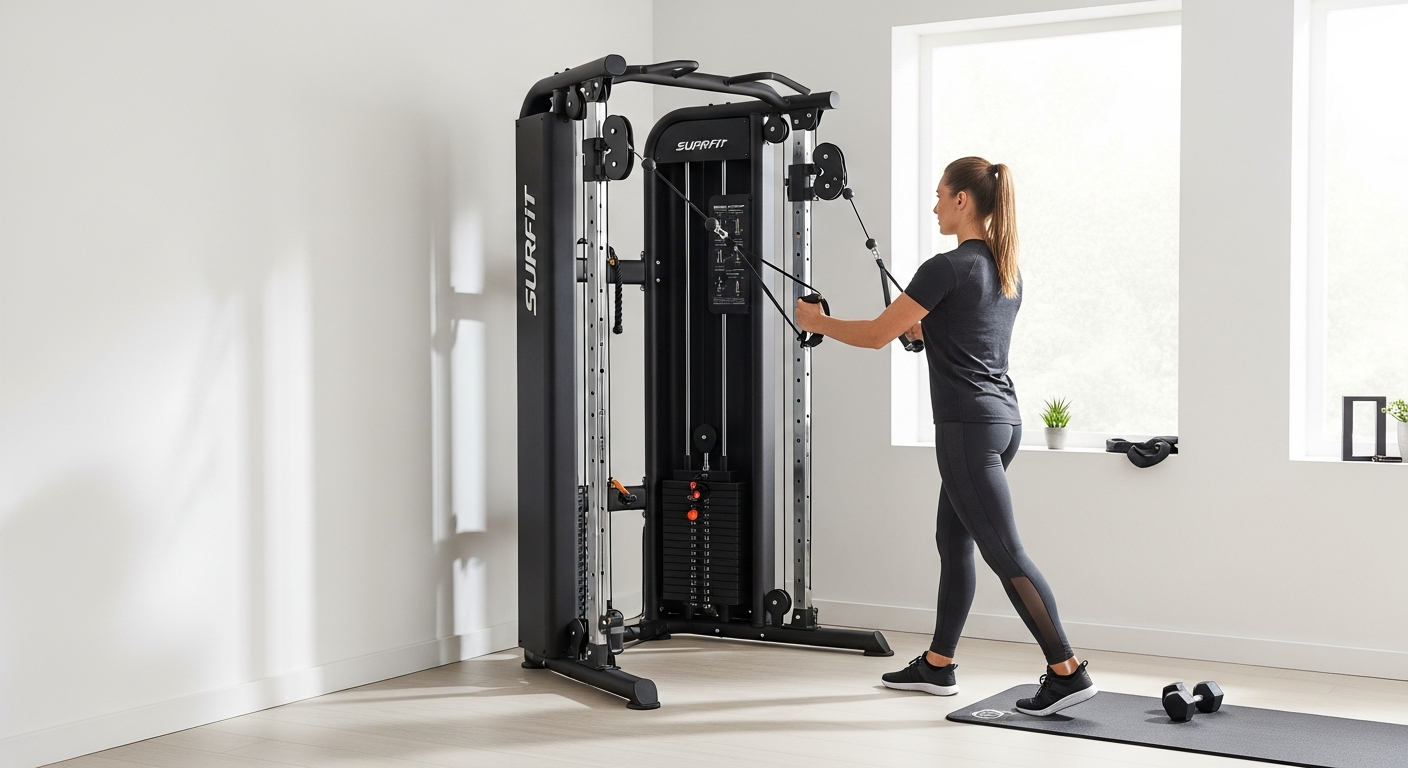
Suprfit recognized this exact pain point and engineered the Hallador Cable Pull Tower with a Basement Edition specifically designed for rooms with lower ceilings. At 200 cm tall versus the standard 216 cm, this all-in-one cable station delivers commercial-quality strength training without demanding the vertical real estate of traditional equipment. It’s a thoughtful solution that brings professional cable exercises into spaces where they previously seemed impossible.
Check the Suprfit Hallador Cable Pull Tower on the official site
This guide covers everything needed to maximize the Hallador Cable Pull Tower in a compact home gym environment. You’ll discover practical space-planning strategies, the full range of exercises available within a tight footprint, assembly insights, and honest details about whether this investment makes sense for your specific setup. By the end, you’ll have a clear picture of how this machine can transform even the most space-constrained workout areas.
The Basement Edition Advantage: Solving the Low-Ceiling Dilemma
Height specifications: 200 cm vs. 216 cm standard edition—what the 16 cm difference means for your space
The 16 cm height reduction separating the Basement Edition from the standard model sounds modest until you measure your actual ceiling. That difference often means the distinction between fitting and not fitting at all. Standard residential basements frequently have 210–213 cm clearance after accounting for flooring materials and mounting hardware. The Basement Edition’s 200 cm height provides genuine breathing room—approximately 10 cm of clearance above the machine, enough for safe operation without the feeling of working in a confined space.
Ceiling clearance requirements: Minimum room height needed for safe operation and full range of motion
Effective cable training demands overhead clearance for several reasons. Lat pulldowns require full arm extension upward, some shoulder exercises involve reaching above shoulder height, and the integrated pull-up bar needs space for grip variations. Minimum functional room height is 210 cm—the Basement Edition’s 200 cm height plus buffer space. Anything below 210 cm will restrict certain exercises and create safety concerns if someone loses control during a movement.
Comparison with traditional cable machines: Why standard equipment often requires 220+ cm clearance
Commercial cable crossovers and functional trainers typically stand 213–220 cm tall due to higher pulley positioning. These machines position their top pulleys further from the floor to accommodate a wider range of motion angles. The Hallador’s design compresses this height requirement by optimizing pulley placement—pulleys sit lower without sacrificing exercise variety. This engineering choice makes the Basement Edition possible without compromising functionality.
Ideal room dimensions: How to measure your space accurately before purchasing
Measure ceiling height at three points: the area where the machine’s center will sit, and two points on either side. Basement ceilings aren’t always perfectly level—variations are common, and you need the lowest point. Measure from finished flooring to any ceiling obstruction. Note ceiling components like exposed pipes, beams, or HVAC ducts that might interfere with the pulleys or weight stacks. Document room length and width with similar precision.
Vertical space optimization: Techniques for positioning the machine to maximize usable room height
Position the Hallador in the lowest-ceiling section if height varies across your space. Some basements have dramatically different ceiling heights depending on wall location. Check where structural supports or mechanical systems run—sometimes positioning 30–60 cm away from the wall creates an extra 5 cm of clearance by moving away from ceiling drops. Tilt your phone’s level app to verify ceiling slopes; angled ceilings are common in basements with floor joists above.
Basement-specific considerations: Humidity, concrete floors, and environmental factors that impact placement
Basements present environmental challenges distinct from above-ground spaces. Humidity causes corrosion, moisture promotes mold, and temperature fluctuations stress joints. Position the Hallador at least 60 cm from exterior walls where groundwater moisture concentrates. Place it on a moisture barrier—plastic sheeting or rubber mats—to prevent concrete moisture from migrating upward into the base. Ensure air circulation around the equipment through dehumidifiers or ventilation fans. The powder-coated steel handles humidity reasonably well, but prevention beats repair.
Clearance zones: Safety buffer space needed around the machine for proper exercise execution
The machine itself measures 298 cm long and 65 cm wide, but functional space requirements extend further. Cable exercises demand movement space: 75 cm in front for lat pulldowns and rows, 75 cm on each side for rotational movements like Pallof presses or wood chops, and 100 cm behind for positions during some exercises. Total functional footprint reaches approximately 450 cm by 215 cm. Measure your actual available space against this requirement—it’s the real space constraint, not the machine’s footprint alone.
Maximizing Workouts in Compact Spaces: Exercise Versatility Without Sprawl
Cable exercise library: 30+ exercises achievable with the Hallador in a small footprint
The Hallador’s design enables a surprisingly comprehensive movement library despite space limitations. The dual weight towers allow simultaneous exercises from opposite sides. Height-adjustable pulleys create varying resistance angles. The integrated pull-up bar with multiple grip positions adds bodyweight training. The plug-in coupling system enables rapid attachment switching between handles, ropes, straight bars, and specialized grips. This combination yields over 30 distinct exercises targeting every major muscle group.
Upper body movements: Chest flyes, lat pulldowns, shoulder raises, and bicep curls using cable resistance
Chest flyes execute perfectly on the Hallador—set pulleys at chest height, stand in the center, and perform horizontal adduction. Lat pulldowns use the pull-up bar or high pulley attachment. Shoulder raises work from any pulley height when adjusted slightly downward. Bicep curls, tricep pushdowns, and lateral raises all execute cleanly with quick pulley adjustments. The dual towers allow one arm to work while the other rests, or simultaneous bilateral work. Shoulder health benefits from the varied angles cable training provides—something fixed equipment struggles to deliver.
Core and functional training: Woodchops, pallof presses, and anti-rotation exercises in tight quarters
Rotational core training thrives on cable equipment because resistance works through the movement arc. Woodchops—diagonal cuts across the body—execute safely and effectively. Pallof presses (resisting rotation rather than creating it) demand surprisingly little space; the user stands sideways to the machine and presses the resistance away. Anti-rotation holds work similarly. These movements engage stabilizer muscles that traditional exercises miss and build functional strength applicable to real-world activities.
Lower body options: Cable leg extensions and curls despite limited floor space
Lower body cable work requires minimal extra space. Cable leg extensions attach to the ankle from standing or seated positions. Cable leg curls work from standing or prone positioning. These exercises work exceptionally well for rehabilitation and muscle isolation. While they don’t replace barbell squats or deadlifts, they deliver targeted leg work without the equipment footprint a squat rack demands.
Bodyweight integration: Pull-up bar variations that don’t require additional equipment
The integrated pull-up bar expands training possibilities substantially. Standard pull-ups and chin-ups build back and arm strength. Hanging leg raises strengthen the core. Assist bands attach to the pull-up bar for progression or regression. Dead hangs improve grip strength and shoulder health. These bodyweight movements require only vertical space, not floor space—a crucial advantage in compact areas.
Compound movement efficiency: How to structure full-body workouts using the dual weight towers
The dual towers enable superset training—alternating between two exercises without rest. Perform a set of cable rows on one tower while your back rests, then transition to chest presses on the other tower while your chest rests. This method maintains workout intensity while allowing muscle groups to recover briefly. A single machine becomes two stations, effectively doubling training density in the same footprint.
Exercise progression: Scaling difficulty without needing more space—just weight adjustments
Strength progression in cable training occurs through weight increases, tempo manipulation, and range of motion adjustments. The concrete-filled weight bowls in 5 kg increments (typical) allow gradual progression. Slowing tempo creates mechanical tension. Reducing range of motion allows heavier loads for specific angles. None of these progression methods require additional space—your compact gym grows stronger without growing larger.
Functional fitness applications: Rehabilitation and mobility work suited to compact environments
Physical therapists frequently recommend cable machines for rehabilitation due to the smooth, controllable resistance and variable angles. Rotator cuff work, shoulder mobility drills, and movement pattern retraining all benefit from cable training. The Hallador’s design accommodates these applications perfectly. Someone recovering from injury can work at any intensity level within the safe movement range.
Explore the Suprfit Hallador’s exercise capabilities and specifications
Space Planning Strategy: Layout and Footprint Considerations
Dimensions breakdown: 298 cm length × 65 cm width—what this footprint actually requires
The 298 cm length and 65 cm width footprint represents the machine’s physical boundaries. This translates roughly to 10 feet long and 2 feet wide—substantial but not enormous for dedicated gym space. However, functional space requirements extend beyond these dimensions. Clearance zones around the equipment, walkways, and space for attachment storage mean you’ll actually need 15 feet by 12 feet minimum for comfortable training. A basement corner measuring 14 by 11 feet technically fits the machine but offers marginal training space.
Minimum room size recommendations: Square footage needed for comfortable setup and movement
Comfortable cable training with the Hallador requires approximately 180 square feet (roughly 16.7 square meters). This accommodates the machine, functional clearance zones, safe walking paths, and some storage space for attachments. Smaller spaces work—100 square feet (9.3 square meters) can function—but crowding creates safety issues. Your training quality directly correlates with having adequate clearance. Measurements matter more than you’d initially expect.
Positioning against walls: How to orient the machine for optimal space efficiency
Position the Hallador perpendicular to the longest wall. This orientation maximizes functional space along the length while the wall backs the machine, reducing clearance needed on one side. Avoid positioning diagonally unless your space specifically benefits. Corners create dead space that usually goes unused; the long-edge-to-wall orientation utilizes space more efficiently. Maintain at least 60 cm from interior walls to avoid moisture issues and allow cable freedom.
Traffic flow patterns: Maintaining safe pathways around the equipment
Define and maintain clear pathways around the machine for safety and efficiency. If the equipment sits in a multipurpose basement, ensure people can walk around it safely without cutting across functional zones. Cable equipment poses trip hazards if pathways cross through weight stacks or attachment storage areas. Plan your layout as if other people will be moving through the space—because they will.
Dual weight tower placement: How individually loadable towers affect your layout options
The dual towers sit on opposite sides of the main frame. This design means the machine’s width is fully used; you can’t push towers closer together. However, it creates flexibility—someone can load the left tower while someone else uses cable attachments on the right. The side-by-side design requires minimum width (65 cm) but allows width to be your limiting dimension rather than length.
Accessory storage solutions: Where to keep attachments, handles, and cables in a compact gym
Store cable attachments, extra handles, and ropes within arm’s reach but outside the functional training zone. Wall-mounted pegboards or small shelving units work effectively. Avoid stacking attachments on the floor—they create trip hazards. Dedicate a small cabinet or storage rack specifically for accessories. Organization prevents time-wasting searches and keeps your compact space functional.
Ceiling obstruction mapping: Identifying and working around pipes, beams, or HVAC systems
Basements often feature exposed piping, ductwork, and structural beams. Map these before positioning your equipment. Pulleys can’t swing into pipes. Some pulley positions might sit directly below HVAC ducts where condensation drips onto the machine. Structural beams might create dead spots where certain exercises become impossible. Walk through every exercise mentally before finalizing machine placement—this prevents realizing after assembly that the shoulder press position hits overhead pipes.
Multi-purpose room integration: Strategies for sharing space with other equipment or activities
If your compact space must serve multiple purposes, position the Hallador to leave the rest of the room usable. Don’t place it dead center. Push it to one side, allowing the remainder for cardio equipment, storage, or other activities. This requires creative planning, but many home gyms share basements with storage areas, workshops, or laundry spaces. Zone your room mentally—assign specific areas for specific purposes.
Weight Capacity and User Suitability: Who Benefits Most from This Setup
Maximum user weight: 150-200 kg capacity and what it means for different body types
The Hallador supports users weighing up to 150–200 kg (approximately 330–440 lbs), depending on the specific tower and configuration. This capacity covers the vast majority of home gym users. For heavier individuals, the machine remains safe for cable exercises but pull-ups on the integrated bar approach or exceed safe limits at maximum user weight. The weight capacity refers to the machine’s structural ability to support the individual performing exercises, not the resistance load.
Load per tower: 71-81 kg per side—sufficient for beginner through intermediate lifters
Each weight tower provides 71–81 kg resistance (approximately 156–178 lbs). For cable exercises where resistance works through a mechanical advantage, this load reaches intermediate to moderately advanced training levels. Lat pulldowns might use 40–60 kg for challenging sets. Cable rows work in similar ranges. Rotational exercises and smaller muscle group movements typically use 20–40 kg. The dual towers allow simultaneous 152–162 kg of total available resistance.
Concrete-filled weight bowls: Durability, stability, and why they’re practical for home use
The Hallador uses concrete-filled plastic weight bowls rather than traditional cast iron plates. Concrete provides excellent density and stability at lower cost. Plastic housings prevent rust in humid basement environments—a genuine advantage over metal. Concrete’s sound dampening creates quieter operation than metal plates would produce. The trade-off is slightly less aesthetic appeal and marginally less compactness than steel would provide, but functionality remains excellent. Home users benefit from the durability and moisture resistance these materials provide.
Beginner-friendly loading: Quick-change coupling system for rapid weight adjustments
The plug-in coupling system allows weight bowl attachment and removal in seconds. No pins to align multiple times. No straps to fasten. Simply unplug the current weight, plug in a heavier or lighter bowl, and continue. For family gyms where multiple users train at different strength levels, this system saves enormous amounts of time. A 30-minute workout doesn’t include a 5-minute weight adjustment period—quick changes preserve training efficiency.
Advanced user considerations: Progressive overload strategies within the machine’s capacity limits
Advanced lifters can progress through several methods without hitting weight limits prematurely. First, increase reps and sets—progression doesn’t demand heavier weight immediately. Second, slow tempo—adding 1–2 seconds to both the lifting and lowering phases creates significant training stress without weight increases. Third, reduce rest periods—performing the same weight with less rest between sets increases intensity. Fourth, advanced angles and movement variations—changing pulley heights or body position modifies difficulty. These methods extend training progression within the machine’s capacity.
Family gym scenarios: How different users can quickly adjust weights for varied fitness levels
A 55 kg woman, a 90 kg man, and a 75 kg teenager can train on the same machine by simply swapping weight bowls. The quick-change system makes this practical. A woman might work with 20 kg per side, while the man uses 50 kg simultaneously on different exercises or the same exercise at different intensities. This flexibility makes the Hallador exceptional for family gyms where strength levels vary significantly.
Long-term progression planning: Realistic strength gains before outgrowing the equipment
A beginner performing consistent cable training typically progresses for 12–18 months before approaching the machine’s capacity limits on most exercises. Intermediate trainees might reach upper limits within 12 months depending on the exercise. This timeframe allows meaningful progress without replacing equipment. For many home gym users, this lifespan justifies the investment—the machine grows with the user through substantial strength gains.
Assembly, Delivery, and Installation Reality Check
Multi-package delivery: Expect 9-11 separate shipments requiring coordination
The Hallador ships in 9–11 separate packages, not a single delivery. This isn’t a flaw; it’s a logistical reality of getting a 298 cm machine through standard shipping channels. Packages arrive over several days or weeks, sometimes randomly ordered. You’ll need to receive and inspect multiple shipments, verify all pieces arrived, and store components safely until you begin assembly. This requires patience and temporary storage space.
Freight delivery logistics: What to prepare before the truck arrives at your home
Most packages come via freight carriers rather than standard parcel delivery. Freight trucks require driveway access and clear pathways to your basement entrance. Prepare by clearing delivery areas, ensuring your basement door can accommodate large boxes, and arranging for someone to be home during delivery windows. Some carriers require signatures. Coordinate with neighbors if necessary—freight drivers won’t haul heavy boxes multiple blocks.
Assembly complexity: Honest assessment of difficulty level and time requirements
Assembly difficulty ranges from moderate to moderately challenging. You’re attaching weight towers, connecting cable systems, installing pulleys, and securing the frame. The instruction manual varies in clarity depending on your language and copy version. Someone experienced with equipment assembly typically completes it in 6–8 hours, including setup of pulleys and cables. First-timers might need 10–12 hours across multiple sessions. It’s not impossible for a determined person, but it’s not trivial either.
DIY assembly timeline: Realistic hours needed for complete setup
Budget 10–12 hours for complete assembly if you’re doing this solo. Organize parts systematically, follow instructions methodically, and don’t rush. Rushing creates errors that become expensive to fix. Some people complete assembly in two 5-hour days. Others break it into four 3-hour sessions. The timeline matters less than taking your time and verifying each step.
Tool requirements: What you’ll need to have on hand before beginning
Standard tools suffice: a socket set, adjustable wrenches, hex key set, and basic screwdrivers. A power drill accelerates bolt installation. A level helps ensure proper alignment. Most home mechanics already own these items. The instruction manual specifies required tools, so review it before packages arrive. Borrowing or renting specialized tools costs less than rushing through with improper tools.
Space needed during assembly: Temporary area for organizing parts and components
Assembly requires temporary space to organize components. Lay everything out before starting—organize by section (weight towers, frame, pulleys, cables). A clear area approximately 300 cm by 150 cm helps tremendously. You don’t want parts scattered across your finished basement with cables entangling other items. Assembly in the final location works, but having staging space prevents chaos.
Professional assembly option: Cost-benefit of hiring help versus DIY approach
Professional assembly typically costs €200–€400. If that cost feels acceptable relative to your time value and comfort level, professional assembly makes sense. You avoid potential errors, get expert setup, and receive documentation that the machine was assembled correctly. If you enjoy hands-on projects and have weekend time available, DIY assembly saves money and provides satisfaction. The cost-benefit depends on your priorities.
Installation in tight spaces: Special considerations for basements or confined areas
Installing in basements requires moving components through doorways and down stairwells. Measure your access route—doorways, staircases, and corners—before components arrive. Can you fit a 298 cm frame piece through your doorway? Sometimes components must come in separate pieces delivered to the basement. If your basement access severely limits logistics, professional delivery and assembly become more valuable.
Durability and Long-Term Performance in Home Gym Conditions
Powder-coated steel construction: Why this finish matters for basement environments
The Hallador’s powder-coated steel construction is genuinely advantageous for basements. Powder coating creates a protective barrier against rust and corrosion. Traditional bare steel would rapidly corrode in basement humidity. The finish holds up reasonably well to moisture if basic maintenance occurs. Scratches expose bare metal underneath, so avoid situations that chip the coating, and touch up small dings with matching paint to prevent rust initiation.
Corrosion resistance: Performance in humid or temperature-fluctuating spaces
Basements present corrosion challenges: high humidity, temperature swings, and moisture intrusion. The powder-coated finish provides excellent protection against these conditions. However, it’s not invulnerable. Once the coating breaches through damage, rust forms quickly in humid environments. Position the machine away from exterior walls where moisture concentrates. Use a dehumidifier to keep humidity below 60% relative humidity. These actions keep the equipment viable long-term.
Cable system longevity: Expected lifespan and maintenance requirements
Steel cables typically last 5–10 years with regular use and no significant abuse. They’ll show fraying or corrosion before they fail completely. Inspect cables monthly for visible damage. Lubricate pulleys quarterly using light machine oil to prevent squeaking and extend pulley life. Replace cables if they show significant corrosion or fraying—replacement is straightforward and far cheaper than replacing the entire machine.
Weight bowl integrity: How concrete-filled plastic holds up to repeated use
Concrete-filled plastic weight bowls prove exceptionally durable for home use. Concrete doesn’t crack under normal training use. Plastic housings won’t rust and resist damage from impacts better than cast iron. The coupling system is the stress point—repeated plug-unplug cycles can eventually wear the connection, though this takes years of frequent use. Inspect couplings annually; replace if you notice looseness or resistance when connecting.
Joint stability: Powder-coated connections and their resistance to loosening
Steel joints and fasteners maintain tightness well in a properly assembled machine. The powder coating doesn’t degrade fastener function. However, vibration during training can loosen bolts over months of use. Check all major connection points quarterly, tightening any bolts that have shifted. This is standard maintenance for any equipment; it’s not a defect.
Maintenance schedule: Regular care tasks to extend equipment lifespan
Monthly: Inspect cables and pulleys for damage or debris. Wipe down the frame to prevent dust accumulation.
Quarterly: Lubricate pulleys with light machine oil. Tighten all visible bolts.
Annually: Deep clean the entire machine. Inspect the powder coating for damage and touch up scratches. Assess the quick-change coupling system for wear.
This minimal maintenance keeps the equipment functioning optimally for years.
Warranty coverage: What Suprfit guarantees and what falls outside protection
Suprfit typically warranties structural defects in materials and workmanship for 2 years. This covers manufacturing failures, structural cracks, and similar issues. Normal wear—cosmetic scratches, cable fraying after years of use, loosened fasteners from regular training—falls outside warranty. Assembly errors sometimes affect warranty claims, making professional assembly or careful DIY important. Verify specific warranty terms with your retailer before purchase.
Replacement parts availability: Sourcing cables, handles, or components if needed
Suprfit maintains parts availability for their equipment. Cables, pulleys, handles, and coupling bowls are available for purchase. Lead times might be longer than typical retail items. European availability is reliable; international orders take longer. Plan replacement needs in advance—don’t wait until something fails to begin sourcing parts. Having spare quick-change couplings and cable attachments as spares prevents training interruptions.
Budget Reality: Is €749.99–€799.99 Worth the Investment?
Price comparison: How the Hallador stacks against other compact cable machines
The Hallador priced at €749.99–€799.99 sits mid-range in the compact cable machine market. Single-stack functional trainers run €600–€800. Commercial cable machines exceed €2,000. Smith machines start around €800. For the combination of dual towers, cable system, integrated pull-up bar, and ceiling-conscious design, the pricing makes sense. You’re not getting a bargain at this price, but you’re not overpaying either—it’s fair value.
Cost per exercise: Value calculation based on movement variety
The Hallador enables 30+ distinct exercises. At €750 and 30 exercises, that’s €25 per exercise type. Compare this to buying individual dumbbells or machines: a proper adjustable dumbbell set costs €300+ for perhaps 10–15 exercise variations. A squat rack adds €200–€400 for maybe 5–8 variations. The cable system’s exercise density makes it exceptional value in that frame.
Space efficiency ROI: Cost relative to floor space consumed
The Hallador occupies approximately 2 square meters of dedicated floor space. At €750 for 2 square meters, you’re paying €375 per square meter. Reasonable commercial gym monthly fees are €50–€100. You’d recoup the equipment cost in 8–15 months of training, then continue training cost-free. The ROI calculation favors purchase if you maintain commitment beyond the initial year.
All-in-one advantage: Eliminating need for multiple single-function machines
An equivalent setup using separate equipment would cost significantly more. You’d need a lat pulldown machine (€400–€700), cable crossover (€500–€1,000), functional trainer (€600–€900), and pull-up bar (€100–€300). The total easily reaches €2,000+. The Hallador consolidates this into a single, space-efficient machine. This consolidation drives remarkable value.
Longevity factor: Expected years of use and cost amortization
Properly maintained, the Hallador should function well for 10+ years. At €750 over 10 years, the annual cost is €75—less than most people spend on a single month of commercial gym membership. Over 5 years of regular use, the annual cost drops to €150. This analysis assumes you actually train consistently; a machine gathering dust provides no value regardless of cost.
Alternative solutions: What you’d need to spend buying separate equipment
Building equivalent training capacity with separate machines costs €2,000–€3,500. A standard cable machine alone runs €1,500+. Trying to build a complete gym with dumbbells, barbells, and plates easily exceeds €3,000 for quality equipment. The Hallador’s value becomes clearer when you examine the cost of creating equivalent capability through other means.
Financing options: Payment plans or bundle deals from retailers
Larger retailers sometimes offer 0% financing for 12–24 months on fitness equipment purchases. This spreads the €750 across manageable monthly payments. Some retailers bundle the Hallador with basic attachments at modest discounts. Compare offers across retailers—pricing and financing terms vary. Shopping strategically can reduce effective cost.
Resale value: Secondary market demand if you eventually upgrade
The Hallador maintains reasonable secondary market value. Equipment in good condition typically sells for 50–70% of original purchase price. This means a €750 purchase might realize €400–€525 if resold after several years. While not exceptional resale value, it’s better than losing the entire investment. Active home gym communities provide reasonable resale markets.
Real User Feedback: What Basement Edition Owners Actually Experience
Assembly praise and complaints: Common user observations about setup difficulty
User reviews commonly mention assembly as the most challenging aspect of ownership. Those with mechanical aptitude find assembly satisfying; those without find it frustrating. Multiple reviewers suggest professional assembly is worth the expense if you lack mechanical confidence. Detailed instruction variations seem to affect user experience significantly—clearer manuals correlate with happier assembly reports. The concrete and plastic components—being lighter than all-steel alternatives—make assembly physically manageable even for less experienced people.
Stability during intense workouts: Feedback on wobbling or shifting during heavy exercises
Stability feedback is overwhelmingly positive. Users report solid, immovable performance even during heavy, intense training. The powder-coated steel frame and wide stance prevent wobbling under cable loads. No users report significant movement or instability when trained at capacity. This stability directly translates to safety and training confidence. Heavy compound movements like cable rows execute without concern about equipment movement.
Cable smoothness: User reports on pulleys and weight stack operation
Cable movement receives consistent praise. Pulleys operate smoothly. Weight stacks move fluidly. Users describe the operation as “buttery smooth” and “frictionless.” The quick-change coupling system works reliably. No users report grinding or resistance in cable movement. This smooth operation matters significantly for training quality—jerky, resistance-filled cable systems create poor exercise performance.
Space satisfaction: Owner perspectives on footprint and ceiling clearance
The Basement Edition satisfies most users regarding ceiling clearance. Owners with 210+ cm ceilings report comfortable operation. Those with tighter spaces note the extra 16 cm versus standard editions was essential. Some users in extremely low-ceiling basements (200–205 cm) express slight regret about marginal clearance, but these represent exceptions. Generally, users praise the ceiling solution that made their training possible. Footprint feedback is mixed—some find 298 cm manageable; others wish it were more compact. Space expectation management before purchase prevents disappointment.
Noise levels: How loud the machine operates during training sessions
The Hallador operates quietly. Cable movement, weight stack drops, and joint movement produce minimal noise—far quieter than barbell training or most commercial gym equipment. Concrete-filled plastic weight bowls create softer impacts than cast iron. Users training in basements appreciate that the equipment won’t disturb upstairs residents. Early morning or late evening training becomes practical.
Aesthetic integration: How the equipment looks in finished basement spaces
Opinions vary on aesthetics. The black powder-coated steel presents a professional appearance. Owners with finished basements describe the equipment as fitting into the space reasonably well, though its size creates visual prominence. Some users would prefer sleeker, more compact designs. Others appreciate the industrial aesthetic. The appearance matters more for basement gyms viewed regularly by family than for utility basements. Most users prioritize function over aesthetics and find the appearance acceptable.
Long-term reliability: Owner reports after 6+ months of regular use
Owners reporting after 6+ months of consistent use describe equipment performing excellently. No unexpected failures or defects appear in user reports. Cables remain smooth. Joints stay tight. Weight couplings function reliably. Frame stability persists. This long-term reliability suggests the equipment is genuinely durable and well-engineered, not just initially functional.
Regret indicators: What makes some users wish they’d chosen differently
Few users express significant regret. Those who do typically cite assembly difficulty (solved by professional help) or space constraints they underestimated (a measurement error before purchase). A small minority express wish for lighter or more compact machines, but these represent niche preferences. The genuinely unhappy users seem to be those who didn’t verify ceiling height before purchasing—discovering after delivery that the machine doesn’t fit. This outcome is preventable through basic measurement.
Alternatives and Comparison: Is the Hallador Right for Your Compact Gym?
Smith machines for small spaces: Pros and cons versus cable training
Smith machines occupy similar floor space to the Hallador but provide different training stimulus. Smith machines restrict movement to vertical planes—excellent for controlled strength development but limited to linear motions. The Hallador’s cable system allows multi-directional training. Smith machines excel for heavy barbell simulation; cables excel for varied angles and functional movements. If your priority is heavy, focused compound lifting, Smith machines compete. If you want movement variety and rotational training, cables win.
Functional trainers: Single-stack alternatives and their limitations
Single-stack functional trainers (cable machines with one weight stack) cost €400–€700 and save space compared to dual-tower machines. However, they limit simultaneous bilateral training—you can’t work both sides simultaneously against resistance. The Hallador’s dual towers enable supersets and compound movements impossible with single-stack machines. Single-stack machines suit beginners; dual towers suit serious training.
Resistance band systems: Budget-friendly but less stable options
Adjustable resistance band systems cost €100–€300, making them budget-friendly alternatives. However, bands provide inconsistent resistance through the movement arc (harder at the end of the movement), unstable training positions, and limited weight progression. Serious lifters outgrow bands quickly. Bands suit travel, light training, or supplemental work—not primary strength training in a permanent home gym.
Plate-loaded machines: Space and cost implications for home use
Plate-loaded machines (where you load Olympic plates directly onto the machine) save space compared to weight stack machines and cost €600–€1,200. However, they require dedicated plate storage, don’t adjust weight as quickly as pin-loaded systems, and limit exercise variety compared to cable systems. If barbell training is your focus, plate-loaded machines complement it. If cables are your primary tool, they’re inflexible.
Cable crossovers: Smaller footprint machines with reduced exercise variety
Some cable machines claim more compact footprints than the Hallador. However, these typically sacrifice height (below 200 cm—too short for many exercises) or pulley positioning variety, reducing exercise options. The Hallador’s height and dual-tower design create more exercise possibilities than more compact alternatives. Smaller isn’t always better if it sacrifices functionality.
Hybrid equipment: Machines combining cable and plate-loaded functions
Some manufacturers create hybrid machines combining cable systems with plate-loading capability. These are exceptionally expensive (€2,000+), occupy even more space, and represent overkill for most home gyms. They make sense only if you’re building a truly comprehensive gym with unlimited space and budget. For compact spaces, the Hallador remains more practical.
DIY cable solutions: Budget builds versus commercial quality
DIY cable systems using PVC pipes, rope, and hardware store pulleys might cost €200–€400. These work for basic training but lack stability, durability, and safety margins of commercial equipment. The Hallador’s engineered design,