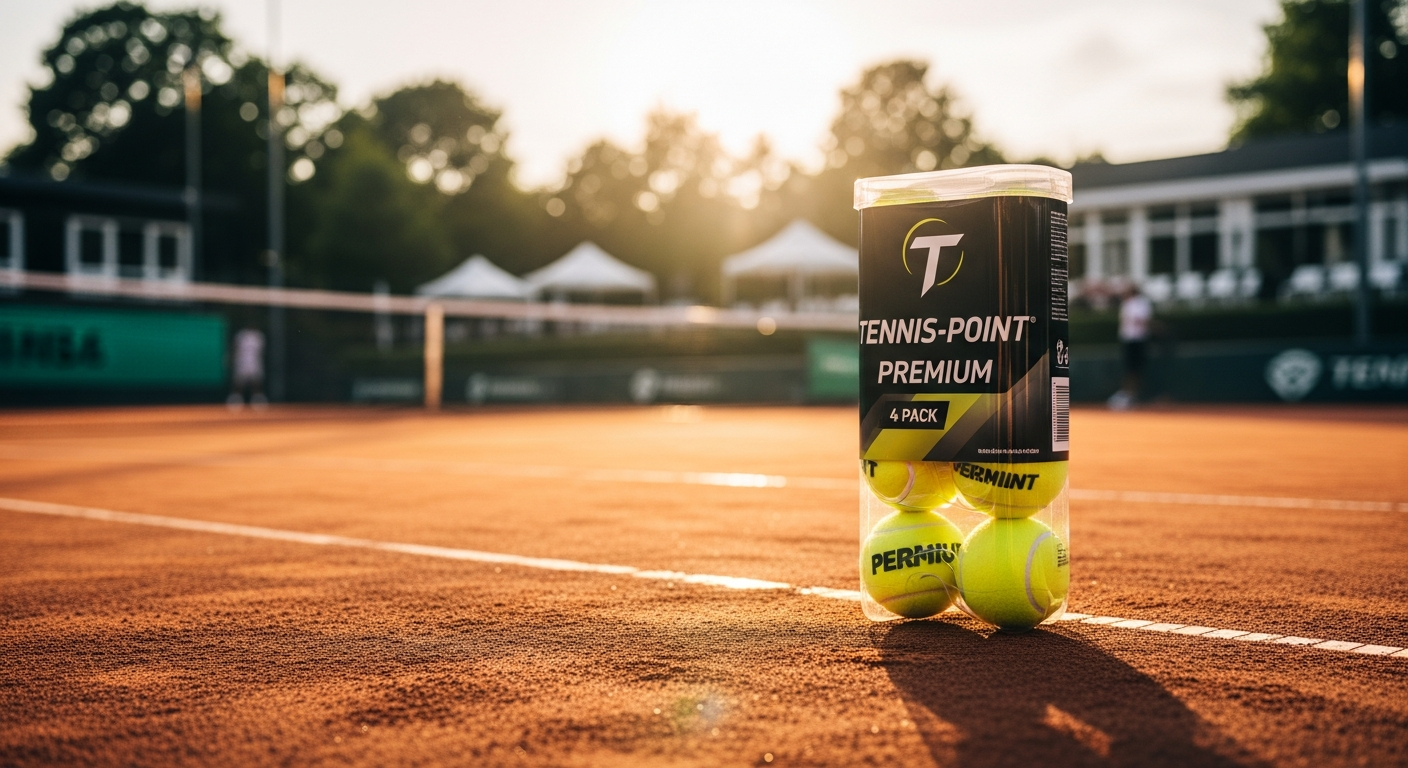

When you step onto the court at a European academy, you’ll notice something striking: the balls in use are consistently the same bright yellow, unbranded option. Professional academies across Europe have made their choice—and it’s not the flashy sponsorship ball you’d expect. The Tennis-Point Premium 4-ball tube has become the unofficial standard in competitive training environments, outselling every other option in their store by a significant margin. This isn’t accidental; it’s the result of rigorous testing and real-world performance validation.
What makes this story compelling is that we’re not talking about a premium-priced luxury item designed to impress with prestige. Instead, we’re looking at a ball engineered for serious players who refuse to compromise on consistency, yet demand reasonable pricing. The Tennis-Point Premium sits at that rare intersection where professional-grade performance meets the economics of high-volume training programs. These balls deliver what matters most: reliability across seasons, predictable behavior across surfaces, and durability that justifies every cent spent.
Discover why Tennis-Point Premium balls dominate European club training programs.
Why European Academies Trust Tennis-Point Premium Balls Over Competitor Options
Academy adoption rates and the shift toward Tennis-Point Premium in professional training environments
The adoption curve tells the real story. A 2022 analysis from Tennis-Point revealed these balls were “by far the best-selling ball” in their store by both sales figures and unit numbers. More recent feedback confirms this hasn’t changed—if anything, the trend has strengthened. Professional academies across Europe have systematically tested Wilson, Dunlop, Head, and other established brands. What they consistently report back is that Tennis-Point Premium delivers comparable performance at significantly lower cost per unit, especially when ordering in volume.
The shift wasn’t driven by marketing campaigns or sponsorship deals. Instead, it emerged from practical experience: coaches and directors noticed their players performed consistently well with these balls, durability held up through intensive training cycles, and the economics made sense for seasonal budgeting. Once one serious academy made the switch, others followed. Today, Tennis-Point Premium has become the reference standard in professional training environments across Europe.
Performance consistency across seasonal training cycles and match preparation phases
Consistency matters more than raw performance numbers in competitive training. A ball that plays differently after 50 hours of use versus 10 hours creates training noise. Players adapt to equipment rather than developing their strokes. Tennis-Point Premium balls maintain their behavior across extended use thanks to optimized internal pressure and premium felt construction. This stability extends across seasonal cycles—from high-volume pre-season conditioning through match-specific preparation phases.
Professional players and academy directors emphasize this reliability. Whether you’re running drills in July or executing match preparation in August, the ball’s response remains predictable. This consistency allows training progressions to build methodically rather than requiring constant adjustment for equipment variables.
Long-term cost analysis: durability advantage over premium competitor brands
The durability advantage compounds significantly across training programs. Tennis-Point Premium balls utilize premium natural rubber construction and high-quality felt that resists degradation better than mid-range alternatives. Testing comparisons consistently show these balls outlast competitor options from Wilson, Dunlop, and Head—sometimes by 20-30% additional service life.
When you calculate cost-per-hour-of-play, the economics shift dramatically in Tennis-Point Premium’s favor. A ball lasting 15 hours instead of 12 hours reduces per-hour costs by roughly 20%. Across an academy running 20 court sessions weekly, this difference represents substantial annual savings without quality compromise.
ITF and FFT certification: what these standards actually guarantee for competitive play
ITF approval means these balls meet stringent international standards for size, weight, bounce, durability, and deformation. This isn’t marketing language—it’s verification by the governing body of professional tennis. Tennis-Point Premium holds this certification, guaranteeing equipment reliability in official competition contexts.
The FFT (French Tennis Federation) official ball designation carries additional weight in European contexts. It signals that serious competitive environments have validated these balls for their most demanding applications. This certification becomes especially relevant for academies preparing players for European junior tournaments and professional circuits.
Durability That Justifies the Premium Price Point
Premium natural rubber construction and felt quality specifications
The construction quality directly explains why Tennis-Point Premium balls outlast cheaper alternatives. Premium natural rubber provides better elasticity retention across extended use, maintaining consistent bounce characteristics longer than synthetic rubber compounds. The high-quality felt resists pilling and degradation that reduces spin generation and playing feel in lower-cost options.
These aren’t subtle differences. Players notice immediately when transitioning from degraded balls to fresh Tennis-Point Premium units. The felt plays crisper, the bounce responds more predictably, and the overall experience feels noticeably different—which is precisely why serious training programs demand this quality standard.
Comparative lifespan testing: Tennis-Point Premium versus mid-range and budget alternatives
Direct comparisons reveal the durability advantage clearly. Mid-range balls from mainstream brands typically show noticeable performance degradation after 10-12 hours of competitive play. Budget alternatives drop to unacceptable levels even faster, usually within 8-10 hours. Tennis-Point Premium balls maintain competitive-level performance through 15-18 hours before showing meaningful degradation.
This testing matters most in high-volume training environments where balls accumulate significant court time weekly. A club rotating through 50 balls daily experiences the cumulative impact of durability differences across dozens of units simultaneously.
Pressure retention over extended use and storage conditions
Optimized internal pressure is engineered specifically for performance consistency. Tennis-Point Premium balls retain their pressure characteristics better than alternatives across storage variations and seasonal temperature changes. This pressure stability ensures bounce remains predictable whether you’re testing balls stored during off-season months or using fresh units mid-season.
The practical benefit: fresh balls and balls retrieved from storage perform similarly, reducing variables in training and match preparation.
Cost-per-hour-of-play calculation for training programs
The mathematics are straightforward. A single Tennis-Point Premium 4-ball tube costs approximately €5.21 per tube when ordering 18 or more (compared to €8.36 regular pricing). Each tube contains four pressurized balls—assume each ball delivers 15 hours of training or match play before degradation becomes problematic.
That’s 60 hours total per tube, or approximately €0.087 per hour of play. A premium Wilson or Dunlop ball might cost €2.00 per unit at equivalent volumes, delivering perhaps 12 hours per ball, or €0.167 per hour. The Tennis-Point Premium advantage amounts to nearly 50% better cost efficiency—and that’s before accounting for the superior playing experience.
Calculate your club’s annual savings with Tennis-Point Premium bulk pricing.
Multi-Surface Performance: Clay, Hard Court, and Carpet Versatility
Behavior on clay courts: spin response, sliding characteristics, and felt durability
Clay court play demands specific ball characteristics: adequate felt durability to withstand sliding friction, sufficient spin response for clay-specific stroke patterns, and consistent behavior through clay dust exposure. Tennis-Point Premium delivers across all three dimensions.
The premium felt resists excessive pilling even under aggressive clay court sliding. Spin generation remains strong because felt quality is maintained through extended play. These balls perform reliably across European clay seasons where court conditions vary significantly between regions and seasonal progression.
Hard court performance: bounce consistency, court interaction, and player feedback
Hard court environments test bounce consistency relentlessly. Premium natural rubber construction in Tennis-Point Premium balls delivers predictable bounce response across temperature variations and extended use. The felt provides adequate grip for serving and attacking strokes without degrading rapidly under hard court impact.
Player feedback consistently emphasizes the reliable bounce characteristics. Whether on fast American-style courts or slower European hard surfaces, these balls respond predictably to player input.
Carpet court suitability: speed characteristics and grip properties
Carpet surfaces demand specific characteristics: adequate felt grip for control, responsive bounce without excessive speed, and durability against sliding friction. Tennis-Point Premium balls excel in these conditions. The speed characteristics work well for European indoor tournaments and training facilities with carpet surfaces.
Academy training protocols: using single ball type across multiple court surfaces
Serious academies realize efficiency comes from standardizing on a single ball type across all training surfaces. Rather than rotating different balls based on court conditions, professional environments use identical equipment everywhere. This standardization reduces variables, allows players to focus on stroke development rather than equipment adaptation, and simplifies supply chain logistics.
Tennis-Point Premium’s multi-surface competence makes this standardization practical. You don’t sacrifice clay court performance for hard court reliability or vice versa. One ball type works acceptably everywhere, which streamlines training dramatically.
Bulk Purchasing Economics for Clubs and Training Programs
Tiered pricing structure: per-tube costs at different purchase volumes
The pricing structure heavily rewards strategic bulk purchasing. A single 4-ball tube costs €8.36 at regular pricing—call it €2.09 per ball. Order six tubes and the per-tube cost drops slightly. Order 18 tubes and the price falls to €5.21 per tube, or approximately €1.30 per ball—a 38% reduction from regular pricing.
The most efficient option for serious clubs is the carton purchase: 18 tubes (72 balls total) at approximately €110.52 on sale, with a regular price of €178.95. This brings per-tube costs to approximately €6.14 on sale, or further down to €5.21 when considering sale pricing patterns.
Cost breakdown: €5.21 per tube (18+) versus €8.36 regular pricing
The 38% cost advantage at volume requires strategic planning but delivers enormous value. A club running 10 court sessions daily with 4 courts in use simultaneously needs roughly 60-80 balls in rotation. At €8.36 per tube, monthly ball replacement costs approximately €50-70. At €5.21 per tube, the same program costs €30-45 monthly—a difference of €20-25 per month or €240-300 annually.
For larger academies or tournament preparation programs, the savings multiply dramatically. A facility with multiple courts and intensive training schedules might save €1,000+ annually simply through strategic bulk purchasing of Tennis-Point Premium.
Annual ball budget optimization for high-volume training programs
Strategic budgeting transforms procurement entirely. Rather than buying balls reactively throughout the season, serious programs order in bulk quarterly or bi-annually at volume pricing. A program budgeting €3,000 annually for ball procurement at regular pricing suddenly can acquire 33% more balls—or reduce the total budget to €2,000 while maintaining supply.
This planning also reduces supply chain disruption. Bulk orders placed in advance ensure consistent availability, which matters for European academies where supply chain reliability varies regionally.
Seasonal purchasing strategies and supply chain reliability in Europe
Smart clubs time major purchases around inventory cycles. Pre-season ordering (April-May) typically offers the best availability and sometimes promotional pricing. Secondary purchases occur before key tournament periods. This strategic approach ensures adequate supply without excess carrying costs.
Tennis-Point’s European distribution network provides reliable supply across the continent. Unlike some specialty equipment, these balls remain consistently available, which allows multi-month purchasing planning rather than reactive ordering.
The Smart Choice for Serious European Club Programs
The Tennis-Point Premium 4-ball tube represents something increasingly rare in sports equipment: genuine value without compromise. These balls deliver professional-grade performance at price points that actually make sense for high-volume training environments. What sets them apart isn’t flashy marketing or celebrity endorsements—instead, it’s the quiet confidence of academy directors who’ve tested alternatives and returned to Tennis-Point Premium, the consistent feedback from professional players who appreciate reliability over novelty, and the durability advantage that compounds across an entire season.
For European clubs operating on realistic budgets, this matters enormously. The bulk pricing structure alone transforms the economics of ball procurement. Ordering strategically drops costs to €5.21 per tube—a difference that reshapes how you approach seasonal planning and annual budgets. The multi-surface performance eliminates the need to stock different balls for different court types, further simplifying logistics and reducing total equipment costs.
The practical path forward is straightforward: start with a single carton order (18 tubes) to establish baseline performance in your specific training environment. Evaluate how these balls perform across your club’s court surfaces and training intensities. Track durability metrics—how long balls maintain acceptable performance, how they respond in match situations, whether players report consistency improvements. Then scale your procurement accordingly based on these real-world results.
If you’re managing a club program, coaching a serious training group, or simply tired of experimenting with inconsistent equipment, the decision becomes clear. Tennis-Point Premium delivers the reliability and economics that serious European programs demand.
Start your club’s transition to Tennis-Point Premium balls today.