

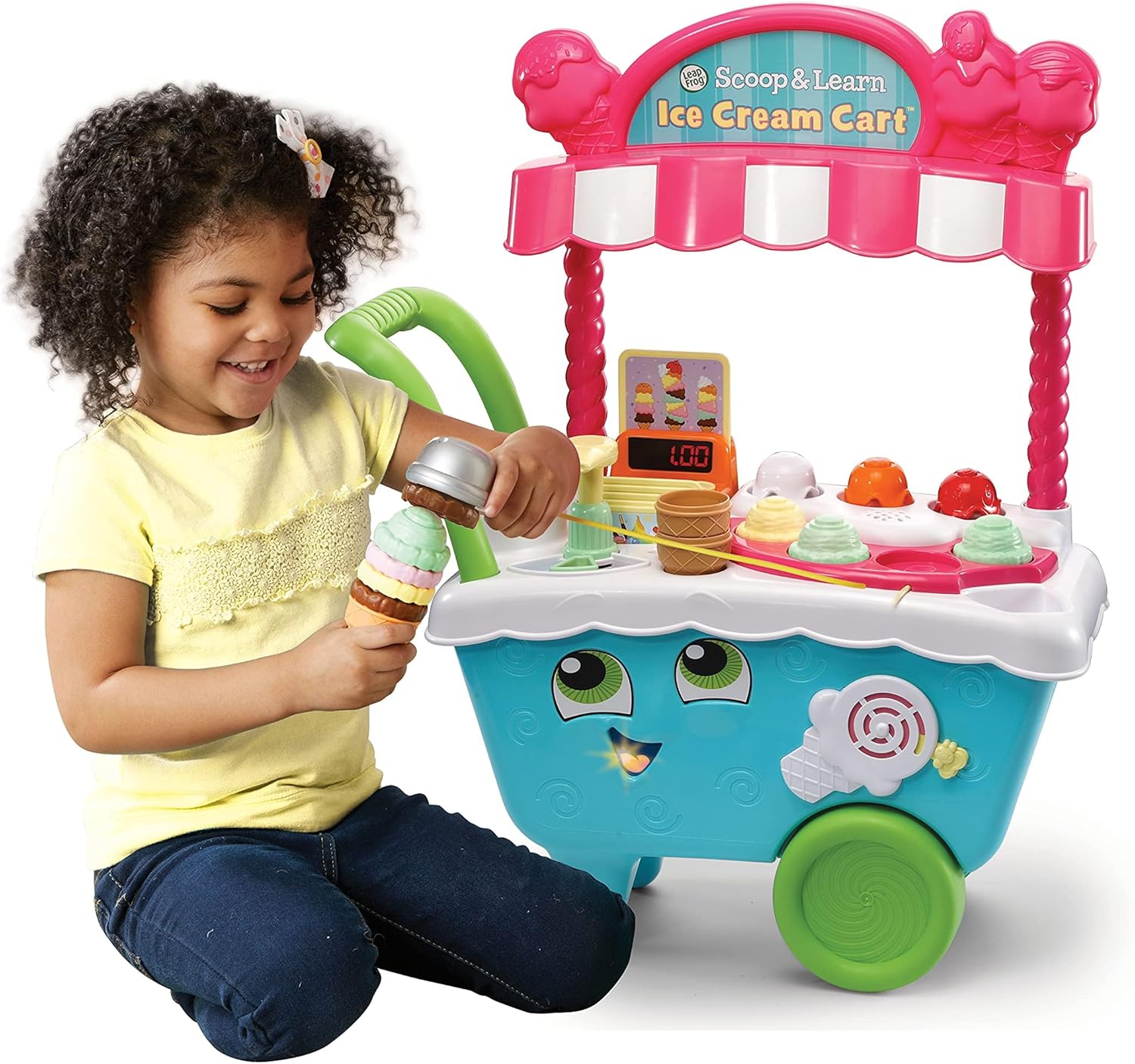
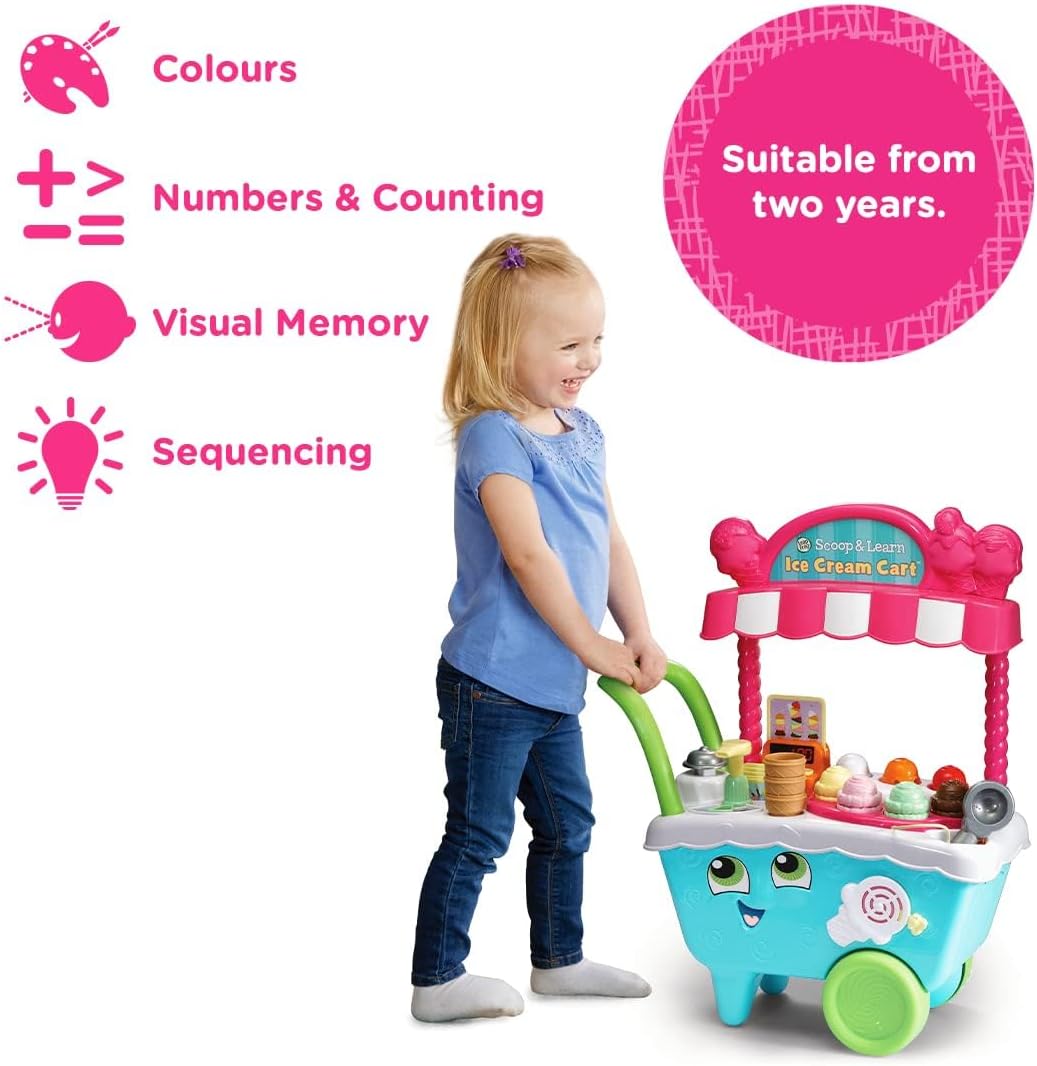
Toddlers and preschoolers love two things: copying grown-ups and making choices. An ice cream cart gives them both in one cheerful package—“What flavour would you like?” meets “That’ll be three scoops, please!” In this guide, we’ll turn dessert-themed play into a daily learning routine you can actually keep up with. You’ll learn how to set up a small “shop corner,” build language and math naturally, prompt social skills like turn-taking and manners, and stretch the toy across ages and abilities. We’ll use the LeapFrog Scoop & Learn Ice Cream Cart as our anchor because it’s a compact, sturdy, feedback-rich system: kids scoop, stack, match orders, press buttons for songs and phrases, and wheel the cart around—so the learning is mobile, multi-sensory, and self-motivating.
Shop LeapFrog Scoop & Learn Ice Cream Cart
Why Pretend Food Play Works (and Keeps Working)
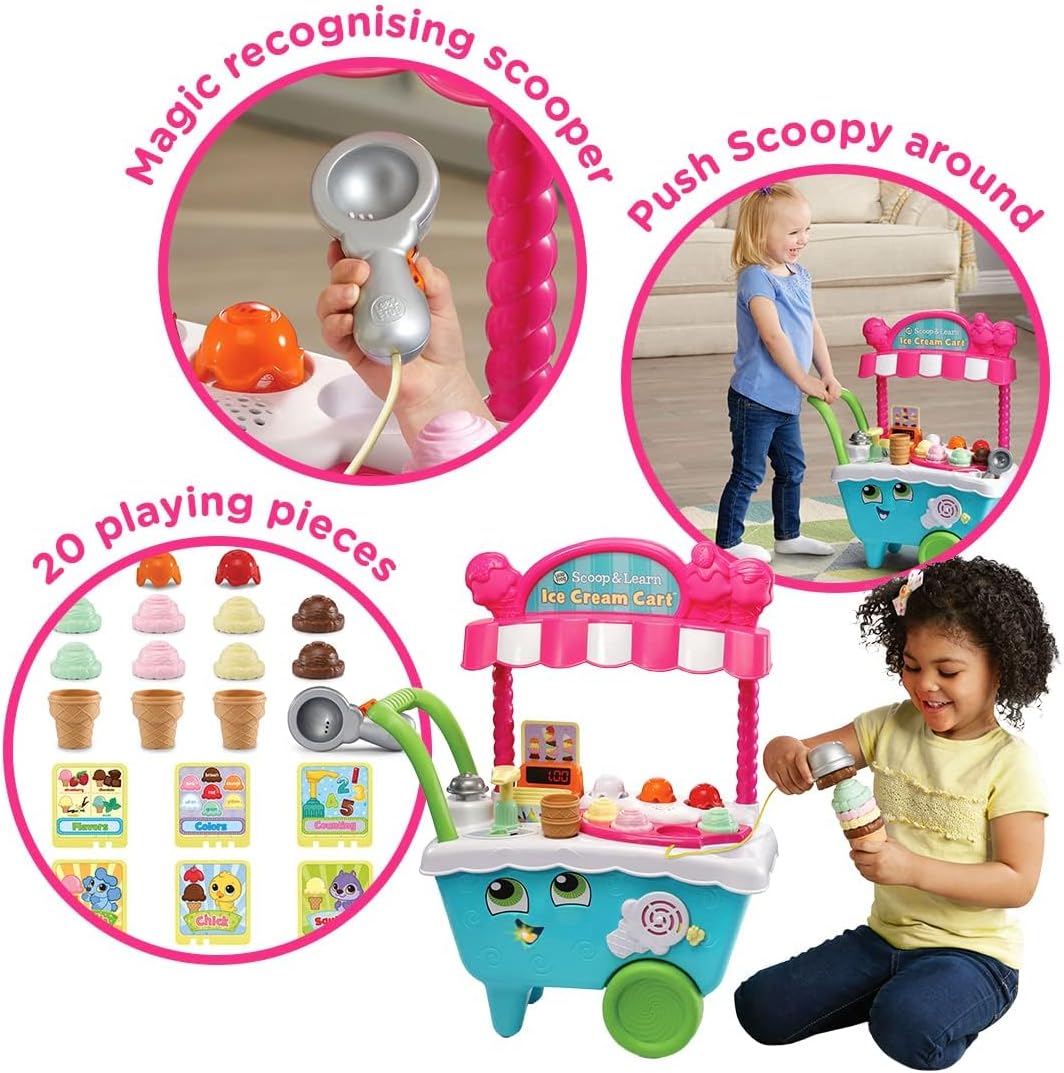
Pretend food is a universal hit because it makes adult routines kid-sized and safe. The LeapFrog Scoop & Learn Ice Cream Cart takes that magic and adds structure: recipe cards, flavour pieces, toppings, a scooper with satisfying “pick-up,” buttons that cue songs and counting, and a cart to push. That mix invites language (“vanilla,” “sprinkles,” “cone”), math (count scoops, match orders), fine motor (grip, alignment), gross motor (pushing, turning), and social-emotional (serving, taking turns, “money” exchanges). And since everything resets in seconds, you get dozens of short, high-quality reps—exactly how early brains wire skills.
Set the Stage: A Shop Corner That Invites Play
A little environment goes a long way. Create a quick “parlour” at home:
- Counter height: Park the cart near a low table or sofa arm so customers can “order” comfortably.
- Menu zone: Tape up a simple menu with pictures of cones, scoops, toppings, and prices using stickers or hand-drawn icons.
- Queue line: Two bits of painter’s tape make a queue; toddlers love rules when they’re visible.
- Payment basket: Pop in pretend coins, a few “notes,” and a small pouch—money handling = fine motor + numeracy.
- Parking spot: Mark a rectangle on the floor with “PARK.” Kids adore returning tools to a home base; it also prevents trip hazards.
The LeapFrog Scoop & Learn Ice Cream Cart becomes the centrepiece, with accessories around it turning random play into a repeatable routine.
Shop LeapFrog Scoop & Learn Ice Cream Cart
Skill Map: What’s Developing Under the Sprinkles
- Language & Vocabulary: Flavours, textures, colours, action words (“scoop,” “stack,” “pay,” “serve”), manners (“please,” “thank you”).
- Early Math: Counting scoops, 1-to-1 correspondence (one scoop → say “one”), simple pricing (“cones are 2”), comparing quantities (“more/less”), patterns (chocolate-vanilla-chocolate).
- Executive Function: Following multi-step orders, pausing to listen, remembering toppings, switching tasks (“Now make Nana’s order”).
- Fine Motor: Pinch-grip for toppings, wrist rotation for scooping, alignment to stack scoops on cones.
- Gross Motor: Pushing and turning the cart, navigating “tight corners,” parking on a taped box.
- Social-Emotional: Taking turns as server/customer, coping with “sold out,” graciously fixing mix-ups, using polite phrases.
- Creativity & Narrative: Naming the shop, inventing daily specials, drawing logos for a sign.
The LeapFrog Scoop & Learn Ice Cream Cart keeps the loop engaging with lights, sounds, and recipe prompts; you layer in conversation and choice to deepen the learning.
Age-by-Age Play Prompts (0-Prep, High-Return)
18–24 months — Sensory & Single Steps
- “Scoop and drop!” (One scoop on a cone; cheer the drop.)
- “Find pink.” (Offer two scoops: strawberry vs. chocolate.)
- “Push to the customer.” (Short walk, then stop at your feet.)
2–3 years — Match & Count
- Show a picture card: “One vanilla, one chocolate.” Count aloud as they stack.
- “Add sprinkles!” (Introduce toppings after success with scoops.)
- “Pay two coins.” (Hand over two large coins; count together.)
3–4 years — Orders & Patterns
- “Make a pattern: strawberry-mint-strawberry.”
- “Total is three.” (Two coins + one note; or three coins.)
- “Delivery!” (Wheel the cart to a sibling; remember the order without looking.)
4–5 years — Menus, Money, and Stories
- Write daily specials with simple prices (e.g., “Rainbow Cone = 4”).
- Role-play busy times: a queue of teddies with different orders.
- Introduce change: pay 5 for a 3-coin cone; count back “two change.”
Shop LeapFrog Scoop & Learn Ice Cream Cart
Language Boost: Talk With Them, Not At Them
Swap quizzing for sportscasting and choice questions:
- Sportscast: “You chose chocolate first, now you’re adding pink sprinkles—tall cone!”
- Choices: “Waffle cone or cup?” “Pay with coins or note?”
- Expanders: If they say “pink,” you add “Pink strawberry scoop—sweet choice!”
Narration plus choice encourages longer sentences and gives shy kids a way in. The cart’s audio becomes your co-teacher; your words anchor the learning to real conversation.
Math That Feels Like Play (Because It Is)
- 1-to-1 Correspondence: Touch each scoop as you count; move coins one-by-one into a jar.
- Comparisons: “You made a cone with more scoops than mine.” “Whose is taller?”
- Simple Addition: “You had two, added one, now there are three.”
- Subitising (see-and-say): Flash two coins in your hand, ask, “How many?” without counting.
- Patterns: AB (choc-vanilla), AAB (straw-straw-mint), ABC (three different). Use toppings as pattern markers.
The LeapFrog Scoop & Learn Ice Cream Cart gives a concrete base—scoops and cones—as manipulatives you can count, compare, and pattern with.
Shop LeapFrog Scoop & Learn Ice Cream Cart
Social Skills: Sharing, Turn-Taking, and Customer Service
- Two-Timer System: 60–90 seconds per role (server/customer), bell rings to swap. Predictable turns reduce “mine!” moments.
- Job Cards: Simple pictures: “server,” “cashier,” “clean-up.” Draw a card, do the job, rotate.
- Kind Fixes: When orders go wrong, model language: “I heard ‘two scoops’—shall I add one more?” Repairing mistakes builds resilience.
Movement Matters: Make It a Mobile Shop
- Delivery Runs: Put three spots around the room (sofa, rug, door). Call out an order, child wheels the cart to the right spot.
- Obstacle Freeways: Use tape to mark lanes; parking at each stop builds executive function (start/stop control).
- Balance Boost: Place a small beanbag on the cart roof—“Keep the ice cream smooth!”—to encourage steady pushing.
The LeapFrog Scoop & Learn Ice Cream Cart is light enough for young kids to manoeuvre yet stable enough to handle “busy hour” energy.
Shop LeapFrog Scoop & Learn Ice Cream Cart
One Hybrid Block (Bullets + Guidance): Your 10-Minute Daily Routine
- Open Shop (1 min): “What’s today’s special?” Place it on the menu with a price.
- Warm-Up (2 min): Two simple cones (one scoop each) to build success momentum.
- Order Round (4 min): Three orders in a row—one from you, one from a toy, one from the child’s idea.
- Math Minute (2 min): Pay and count change or build a pattern cone.
- Close Shop (1 min): “Last order!” Park the cart, return pieces, high-five the cashier.
Routines make learning feel safe and predictable. The cart’s quick reset supports daily micro-sessions that stack up over weeks.
Sensory & Accessibility Notes
- Volume: Start on low; raise if you’re playing in a noisy space.
- Textures: Let sensitive kids explore scoops/toppings with hands first; add sounds later.
- Visual Schedules: Use a simple card strip (Open → Order → Pay → Serve → Park) to support children who benefit from structure.
- Alternative Inputs: If stacking is tricky, play “flavour sorter”—place scoops into labelled bowls by colour or initial letter.
The LeapFrog Scoop & Learn Ice Cream Cart flexes from quiet, tactile exploration to lively shop role-play.
Shop LeapFrog Scoop & Learn Ice Cream Cart
Extend the Learning: Beyond the Cart
- Real-World Bridge: Visit a café; take a photo of the menu; recreate two items at home with scoops and cones.
- Writing Corner: Keep chunky crayons nearby; kids can “write” receipts or stamp loyalty cards.
- Storytime Tie-In: Read a short story about shops; open your “parlour” afterwards.
- Healthy Food Talk: Use toppings to discuss sometimes-foods vs. everyday foods—neutral, no moralising.
- Colour Mixing: Pretend to mix flavours; talk about what new colour it might become (“pink + brown →?).
Care & Storage: Keep Pieces Together (and Your Sanity)
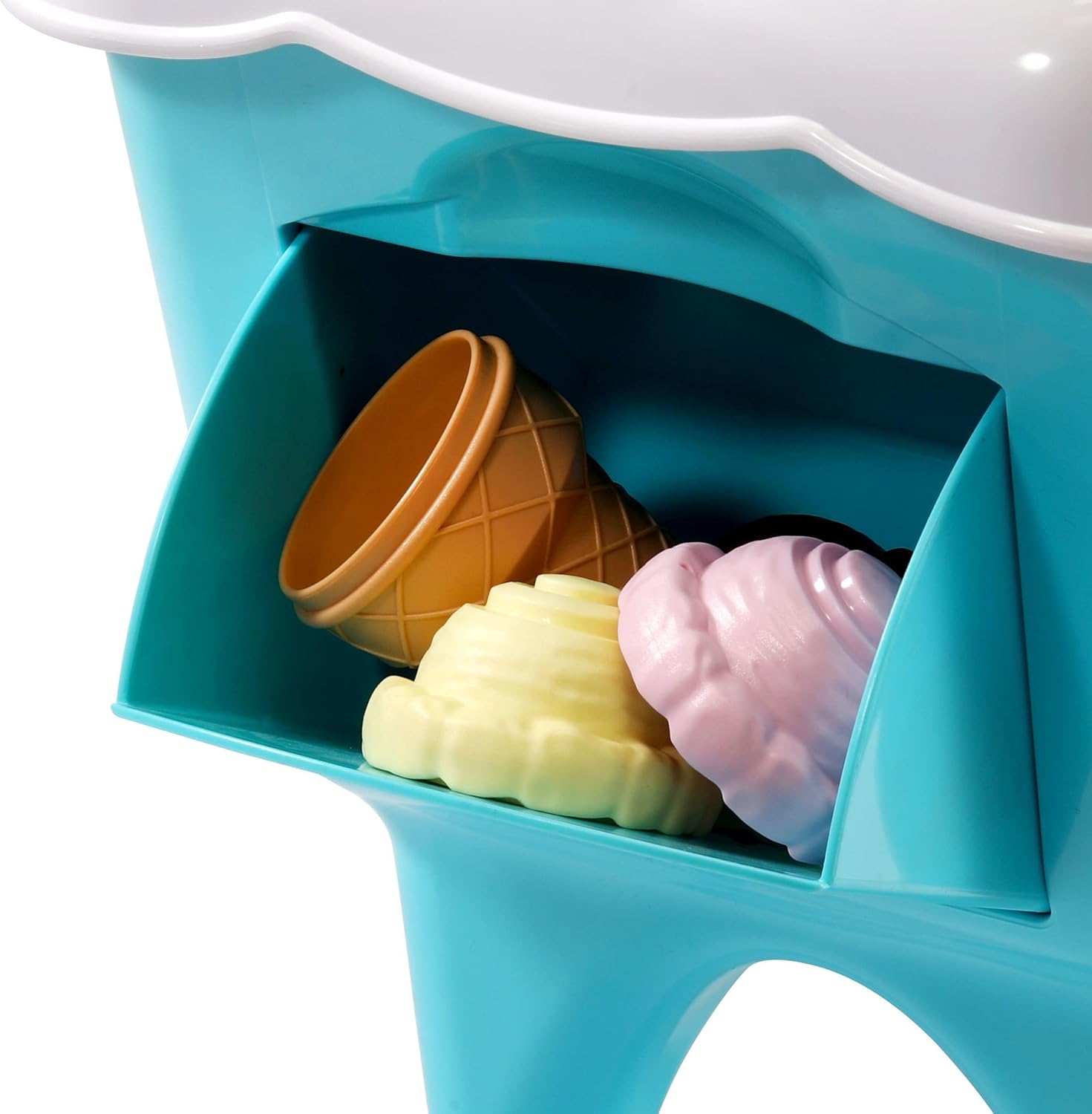
- End-of-Day Sweep: Count scoops and cones back into a small, labelled tub inside the cart.
- Wipe & Dry: Quick wipe of buttons/handle; air-dry if any water got involved in “cleaning the shop.”
- Battery Check: Fresh batteries keep audio crisp and reduce frustration from mis-fires.
- Parking Habit: Return to the PARK rectangle; families report this single visual cue reduces clutter the most.
Troubleshooting: Common Hiccups, Calm Fixes
- Only pressing buttons, won’t scoop: Make pressing the “order bell” a start cue, then require one scoop before any more button presses.
- Meltdowns over turns: Use the two-timer system + visible queue line; praise handovers (“Thanks for serving me!”).
- Losing interest fast: Drop the order difficulty; one-scoop wins → then add a topping; keep sessions short and fun.
- Pieces go missing: Name each piece (e.g., “Mr. Strawberry”) and do a two-minute “closing inventory” song.
- Money confusion: Start with one coin per scoop; progress to mixed coins later.
Shop LeapFrog Scoop & Learn Ice Cream Cart
Parent Wins: What Good Progress Looks Like
- Longer sequences: from “one scoop” to “two scoops + topping + pay.”
- Clearer speech: flavour words and polite phrases appear in daily talk.
- Better patience: waiting in the queue without prompts.
- Early maths: spontaneous counting, noticing “more/less,” building simple patterns.
- Pride: announcing “Shop open!” and inviting you to order.
Conclusion
Pretend food isn’t fluff—it’s a world-class teaching tool hiding in sprinkles and songs. When you pair a feedback-rich toy like the LeapFrog Scoop & Learn Ice Cream Cart with a tiny bit of environment (menu, queue, money basket) and a repeatable micro-routine, you unlock daily practice in language, maths, motor planning, and social grace. Keep the prompts simple, the sessions short, and the praise focused on effort—“You listened, you counted, you fixed the order!” The result? A child who can serve up confidence by the scoop and carry those skills from the playroom to real-world moments with family and friends.
Shop LeapFrog Scoop & Learn Ice Cream Cart
FAQ
- What age range is this best for?
Typically 18 months to 5 years. Younger toddlers enjoy scooping and button feedback; preschoolers thrive on orders, menus, and money. - Does it help with real-life skills?
Yes—turn-taking, manners, counting, following instructions, and tidy-up routines transfer directly to daily life. - How long should a play session be?
5–10 minutes of focused, happy play beats 30 minutes of dragged-out sessions. Do multiple short “shop openings” per day. - Can siblings share without fights?
Use a visible queue and a 60–90 second timer. Add job cards so someone can be cashier while another serves. - What if my child only wants to push the cart around?
Great—movement is learning. Add “delivery orders” at stations around the room to weave in language and counting. - How do I add more maths without worksheets?
Price cones, count coins, compare heights, build patterns with flavours, and play “make 5” with mixed coins. - Any sensory tips?
Start with low volume, explore pieces by touch, and use a visual schedule for kids who rely on routine. - How do I keep pieces from disappearing?
End each session with a 60-second “closing inventory” song while counting scoops and toppings back into a labelled tub.