
Nearly 60% of women trying to conceive or avoid pregnancy naturally struggle with inconsistent basal body temperature tracking—yet the science behind it is rock solid. Manual thermometers, spreadsheets, and guesswork have dominated this space for decades, leaving many frustrated with inaccurate readings and missed fertile windows. The Ovy Bluetooth Basal Thermometer changes that equation entirely.
Basal body temperature tracking forms the backbone of the symptothermal method, one of the most scientifically validated natural fertility approaches available. Developed in Germany with rigorous attention to data privacy and medical accuracy, the Ovy thermometer bridges the gap between traditional temperature tracking and modern smartphone technology. Unlike standard digital thermometers, this device measures BBT to two decimal places—the precision level that actually matters for cycle prediction and contraception planning.
Discover how the Ovy thermometer can transform your cycle tracking today.
How Basal Body Temperature Tracking Works (And Why Precision Matters)
Basal body temperature is your lowest resting temperature, measured immediately upon waking before any physical activity. Your BBT rises slightly—typically 0.4 to 0.8°C—after ovulation occurs, triggered by increased progesterone production. This temperature shift is measurable, consistent, and scientifically reliable, making it one of the most dependable indicators of whether ovulation has occurred.
The reason precision matters becomes immediately clear when you understand what you’re measuring. A standard thermometer might read “98.6°F,” but your actual temperature could be anywhere within a range of 0.5°C. When tracking fertility, that margin of error can mask the subtle rise that signals ovulation. The Ovy thermometer’s ±0.05°C accuracy eliminates this guesswork. It measures to two decimal places—distinguishing between 36.50°C and 36.55°C—capturing the micro-shifts your body produces.
BBT tracking differs fundamentally from other fertility monitoring methods. Ovulation predictor kits (OPKs) detect the hormone surge that precedes ovulation, giving you a 24-48 hour heads-up about your fertile window. Cervical mucus observation tracks consistency changes that indicate fertility. Cervix position monitoring notes physical changes in the cervix itself. The Ovy thermometer, by contrast, confirms ovulation has already occurred by detecting the temperature shift afterward. When combined—the symptothermal method’s core strength—these signals provide comprehensive cycle intelligence rather than relying on any single indicator.
Consistent BBT data builds reliable predictions. After tracking three months of temperature patterns, most women recognize their cycle length, ovulation timing, and luteal phase duration. The Ovy app’s algorithms analyze this data to predict your next fertile window before it arrives. This predictive power only works with accurate, consistent measurements. A single missed day or an inaccurate reading can disrupt pattern recognition, which is exactly why automatic data transfer matters.
Common measurement mistakes compromise accuracy. Measuring at different times disrupts results—your temperature fluctuates based on sleep duration and wake time. Taking your temperature after getting out of bed, exercising, or eating introduces errors. Mouth breathing instead of nasal breathing during measurement produces lower readings. The solution is ritual: same time each morning, immediately upon waking, before any movement or activity. The Ovy thermometer’s three-minute protocol standardizes measurement time, aligning with medical guidelines for accurate BBT readings.
Ovy Thermometer Technical Specifications & Hardware Design
The Ovy Bluetooth Basal Thermometer’s ±0.05°C accuracy means your readings fall within 0.05 degrees of the true temperature. This specificity matters because ovulation shifts your baseline temperature by only 0.4-0.8°C across multiple days. With precision at two decimal places, you can reliably distinguish between your pre-ovulation baseline and your post-ovulation elevated baseline. Standard digital thermometers simply cannot provide this level of accuracy.
The three-minute measurement protocol aligns with clinical standards for basal thermometer use. This timing allows your thermometer’s sensor to stabilize and capture your core body temperature accurately. Rushing to a two-minute reading produces unreliable data; extending beyond three minutes adds no additional benefit. The timer built into the Ovy thermometer ensures you’re measuring for exactly the right duration.
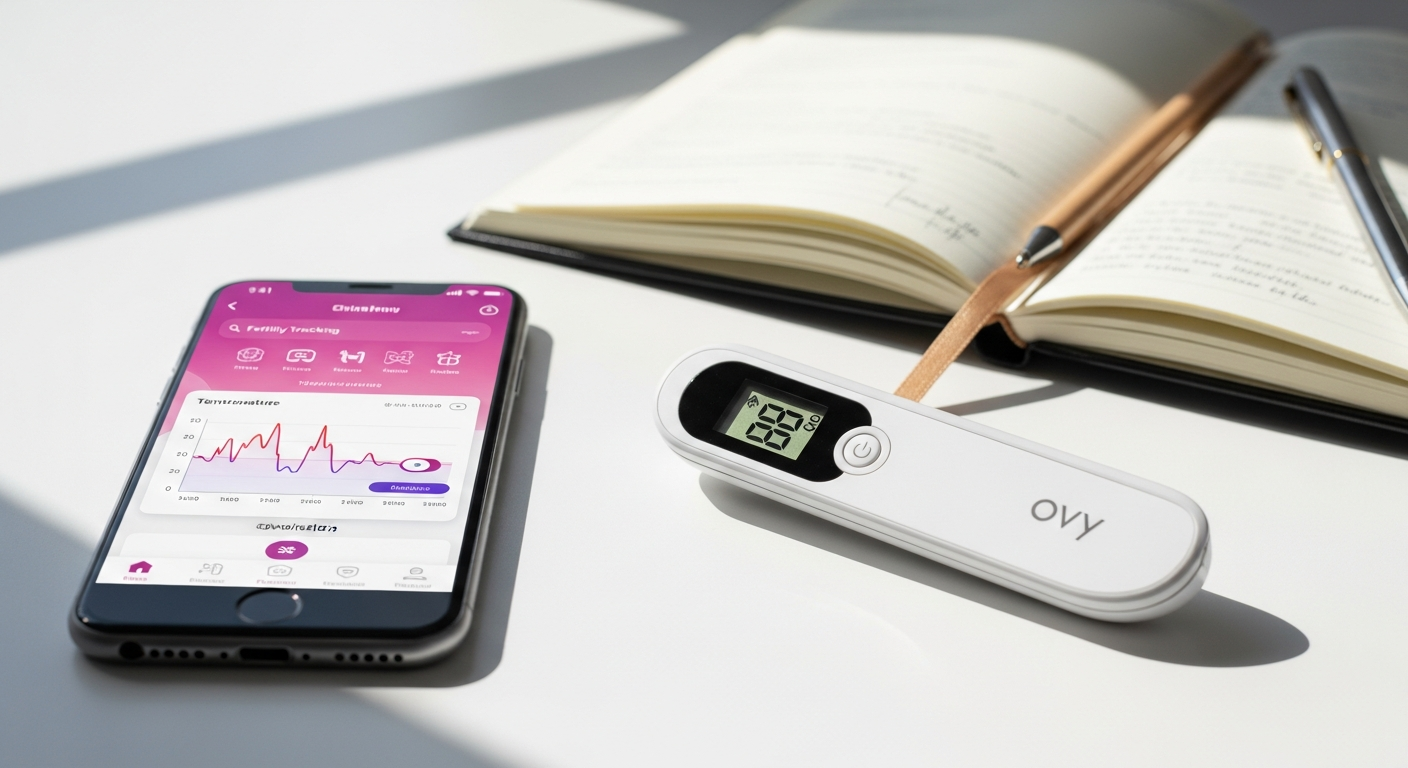
Bluetooth Low Energy 4.0 connectivity automatically transmits your temperature reading to the Ovy app immediately after measurement completes. This automatic transfer eliminates manual entry—a common source of transcription errors. You’ll never again mistype a temperature or accidentally skip a day’s entry. Your reading appears in the app within seconds, and the device stores up to 30 measurements locally as backup.
The illuminated LED display glows softly so you can read your temperature in the dark without turning on overhead lights, which could disrupt your partner’s sleep or fully wake you before measurement completes. The display is easy to read and bright enough for quick confirmation of your reading.
A flexible measuring tip accommodates both oral and vaginal measurement. Vaginal measurement typically produces readings approximately 0.3-0.5°C higher than oral readings and offers superior consistency for BBT tracking. The flexible tip design is comfortable for extended periods and won’t cause strain during your three-minute measurement window.
The rechargeable lithium-ion battery (3.7V/240mAh) provides over 60 measurements per charge—roughly two months of daily tracking before recharging becomes necessary. The USB charging cable connects to any standard USB power source. Battery life is predictable and reliable, and the device includes a two-year warranty covering manufacturing defects.
Smart Features That Eliminate Manual Tracking Errors
Automatic Bluetooth data transfer represents a genuine quality-of-life improvement. You measure your temperature, the device connects to your phone, and your reading appears in the app—no manual steps, no opportunities for error. This automation is particularly valuable for early morning measurements when you’re still groggy and prone to mistakes.
Customizable notification settings transform the measurement experience. You can choose a subtle vibration, a quiet beep, or complete silence when your three minutes complete. A vibration-only mode is ideal for shared sleeping arrangements—your thermometer alerts you without disturbing your partner. This small feature acknowledges that real life often involves shared beds and competing sleep needs.
Real-time sync with the Ovy app means your temperature data feeds into cycle analysis immediately. The app begins interpreting patterns as soon as sufficient data accumulates, rather than waiting for manual input that might occur hours or days later. Immediate analysis also lets you confirm measurements were recorded correctly, catching any data transmission issues quickly.
Your temperature history stores both on the device (30 measurements) and in the cloud through the Ovy app. This dual storage approach protects against data loss while ensuring you can access your complete temperature history across multiple devices. Log in from your phone, tablet, or computer and see your full cycle data.
Data validation features flag unusual readings that might indicate measurement error—temperatures that are physiologically impossible or deviate dramatically from your baseline. This alert system catches problems before they skew your cycle analysis. An anomalously high reading might indicate you measured after getting out of bed rather than upon waking; the app alerts you to review the context.
Integration with the symptothermal method’s multi-signal approach allows you to combine temperature data with cervical mucus observations and cervix position notes within the same app. Rather than tracking temperature in one place, mucus patterns in a notebook, and position notes mentally, everything centralizes in one location where the app connects these signals to identify your fertile window with greater precision.
Ovy App Integration: From Temperature Data to Actionable Insights
The Ovy app transforms raw temperature data into fertility predictions through sophisticated algorithms. The app doesn’t simply store your temperatures—it analyzes patterns, identifies your individual cycle characteristics, and provides predictions specific to your body rather than generic fertility windows.
Ovulation window detection works by analyzing your temperature shift pattern. Most women experience a sustained temperature elevation lasting at least three days following ovulation. The app identifies when this shift occurs by comparing recent temperatures to your pre-ovulation baseline. Once ovulation is confirmed by the temperature rise, the app marks your fertile window—the five days leading up to ovulation and ovulation day itself, when conception is possible.
Cycle pattern recognition emerges after three months of temperature tracking. The Ovy app learns your typical cycle length, your usual ovulation day within that cycle, and your luteal phase duration. This personalization matters because “normal” cycles vary widely. One woman might consistently ovulate on cycle day 14; another on cycle day 21. Once the app understands your pattern, it begins predicting future cycles with remarkable accuracy.
Prediction features forecast your next period and upcoming fertile window based on historical patterns. After sufficient data accumulates, the app can predict your next ovulation date weeks in advance. This predictive power is what makes cycle tracking practical for real-world fertility management—you know when to expect your fertile window, giving you time to plan whether you’re trying to conceive or avoiding pregnancy.
Integration with cervical mucus and cervix position observations adds context beyond temperature alone. You might note that your cervical mucus became clear and stretchy on cycle day 12, observe that your cervix rose and softened on cycle day 13, and see your temperature rise on cycle day 15. The app synthesizes these signals to identify ovulation with greater confidence than any single indicator provides.
Premium versus free features create a tiered system. Basic temperature logging and entry of other cycle signs remain free. The “Contraception” mode—which identifies safe days for hormone-free contraception using the symptothermal method—requires a premium subscription. Detailed cycle curve analysis, extended history viewing, and advanced prediction features likewise sit behind the premium paywall. Most women find basic features sufficient for conception planning; contraception-focused users almost always upgrade to premium for access to the full method protocols.
German-based data storage and privacy compliance appeal to users concerned about data security. The Ovy app stores health data within Germany, subject to GDPR regulations that grant users significant data protection rights. Your temperature data remains your own; Ovy doesn’t sell data to third parties or use it for advertising. For many European users (and health-conscious users globally), this privacy-first approach differentiates Ovy from U.S.-based fertility apps.
iOS (10.0 or later) and Android (5.0 Lollipop or later) compatibility ensures broad device support. Most smartphones from the past seven years meet these requirements. The app performs smoothly across both platforms, with consistent functionality regardless of whether you use an iPhone or Android device.
Use Cases: Who Benefits Most From This Thermometer
Natural contraception seekers using the symptothermal method represent Ovy’s core audience. If you’re avoiding hormonal contraception but want reliable, science-based protection, the symptothermal method offers 99.4% effectiveness when applied correctly—comparable to many hormonal methods. The Ovy thermometer eliminates the measurement inconsistencies that undermine method effectiveness, making natural contraception more reliable than it’s ever been.
Fertility planners and couples trying to conceive optimize their timing through precise ovulation identification. Rather than guessing your fertile window or buying expensive ovulation predictor kits monthly, temperature tracking combined with the Ovy app identifies exactly when ovulation occurs in your individual cycle. This certainty transforms conception planning from a months-long guessing game into a data-driven process.
Cycle awareness enthusiasts seeking deeper understanding of menstrual patterns discover surprising insights through consistent tracking. Many women report that understanding their temperature shifts, mucus patterns, and energy levels across their cycle enhances self-knowledge. You begin recognizing that certain symptoms align with specific cycle phases rather than appearing random.
PCOS and irregular cycle management requires consistency despite hormonal variations. Women with polycystic ovary syndrome often experience irregular cycles where ovulation timing is unpredictable. Consistent BBT tracking reveals whether ovulation occurred during an otherwise irregular cycle, providing crucial information for contraception or fertility planning. The Ovy app’s pattern recognition accommodates irregular cycles better than many generic fertility apps designed around 28-day baselines.
Postpartum cycle re-establishment monitoring tracks temperature patterns after pregnancy. Your cycles take time to normalize following delivery, especially if breastfeeding. Temperature tracking reveals when ovulation resumes and your cycle stabilizes, guiding postpartum contraception decisions or conception planning after pregnancy.
Perimenopause tracking captures hormonal shifts during the transition to menopause. As your cycle changes in the years preceding menopause, understanding your temperature patterns helps distinguish normal menopause-related changes from medical concerns. Temperature data provides objective information about what your body is experiencing during this transition.
Breastfeeding mothers identifying cycle return while exclusively nursing gain confidence in knowing when fertility actually resumes. Lactational amenorrhea isn’t a reliable contraception method, but your temperature will clearly indicate when ovulation returns. The Ovy thermometer removes uncertainty about postpartum fertility during breastfeeding.
Cost Breakdown: Investment vs. Long-Term Value
The device itself costs €79.99, a one-time investment providing two years of manufacturer warranty coverage. The package includes a USB charging cable and documentation. New buyers receive one month of free Ovy Premium subscription, allowing you to experience advanced features before deciding whether to subscribe.
Premium subscription pricing varies by region but typically costs around €4.99 monthly or €39.99 annually. The annual plan provides meaningful savings compared to monthly subscription. Most committed users choose annual subscription rather than month-to-month.
Premium features unlock contraception mode and detailed cycle curve analysis. Contraception mode implements the full symptothermal method protocol, identifying safe days and unsafe days based on your temperature, mucus, and cervix observations. Cycle curve analysis displays your temperature patterns visually across multiple cycles, helping you understand your individual temperature shift magnitude and consistency.
The cost comparison to alternatives reveals the value proposition. A year of ovulation predictor kits costs $50-100 depending on cycle length and brand. Fertility apps without hardware typically cost $10-15 monthly. Professional fertility clinic monitoring through ultrasound can cost hundreds of dollars per cycle. The Ovy thermometer plus annual subscription totals roughly €119.98 yearly—comparable to OPK costs but providing superior data and the capability for contraception use.
Long-term value calculation depends on your intended use duration. If you plan to track for five years, you’re investing €299.95 total (device plus subscription). If you use the device for ten years, you’re investing €499.95 total—less than $50 annually. The device’s rechargeable battery and durable construction support extended use, making the per-year investment decrease over time.
Potential savings from avoiding unplanned pregnancy or optimizing conception timing can be substantial. Unplanned pregnancy involves significant costs—medical care, time off work, childcare expenses. If the Ovy thermometer helps you prevent an unplanned pregnancy or successfully conceive when you’re ready, the device pays for itself through avoided or planned expenses.
Strengths That Set This Thermometer Apart
Medical-grade accuracy specifically calibrated for basal body temperature distinguishes the Ovy from consumer-grade digital thermometers. The ±0.05°C precision targets the exact use case—capturing the subtle temperature shifts that indicate ovulation. This isn’t an incidental feature; it’s the core engineering requirement.
Seamless automation reduces user burden and human error throughout your tracking journey. Automatic data transfer eliminates transcription mistakes. Consistent measurement protocol (via three-minute timer) prevents timing variations. Customizable alerts accommodate real-world sleeping arrangements. Each feature acknowledges that perfect adherence requires removing friction.
Privacy-first design with German data storage and GDPR compliance appeals to users prioritizing data security. Your health information isn’t stored on servers administered by companies with broad data-sharing practices. GDPR grants you explicit rights over your data—access, correction, deletion—that are legally enforceable. This transparency stands in contrast to many U.S.-based health apps.
Gynecologist recommendations and clinical validation of the symptothermal method provide reassurance about the scientific foundation. Ovy didn’t invent temperature-based cycle tracking; gynecologists have validated this method for decades. What Ovy did was modernize the implementation, removing barriers that made manual tracking frustrating and error-prone.
User-friendly interface balances technical precision with simplicity. The thermometer’s LED display is straightforward; the app’s design doesn’t overwhelm you with unnecessary complexity. You enter temperature and optional observations, and the app handles the analytical heavy lifting without requiring you to understand the underlying algorithms.
Discreet measurement options for privacy and partner considerations acknowledge that fertility tracking sometimes involves sensitive circumstances. The vibration-only alert mode, silent notification options, and private app access allow you to track without broadcasting your intentions.
Comprehensive app ecosystem providing context beyond temperature alone means you’re not trapped in a single-signal analysis. Temperature data alone can’t definitively identify ovulation; it confirms ovulation after it’s occurred. By integrating mucus observations and cervix position notes, you gain predictive power for identifying your fertile window before ovulation happens.
Established brand reputation and community support within fertility tracking spaces reassures new users that they’re adopting a trusted tool. The Ovy community across Reddit, fertility forums, and social media platforms shares real-world experiences and troubleshooting advice, creating peer support that extends beyond customer service alone.
Limitations & Realistic Expectations
App dependency means the full functionality requires the Ovy app ecosystem. You can technically read your temperature from the device’s display, but you won’t benefit from cycle analysis, predictions, or contraception mode without using the app. If you’re uncomfortable with app-based health tracking or prefer offline records, this dependency might frustrate you.
Premium paywall for advanced features beyond basic temperature logging creates ongoing costs. Contraception mode—arguably the most valuable feature for many users—requires a subscription. If your intended use is natural contraception, premium subscription isn’t optional; it’s essential. This layered pricing model means your initial investment extends beyond the device’s purchase price.
Not a contraceptive device itself, the thermometer is a tool for informed decision-making. The device and app provide information about your fertility; they don’t prevent pregnancy. Effectiveness depends entirely on your consistency in measuring daily and your knowledge of the symptothermal method’s protocols. Occasional missed days, measurement errors, or misunderstanding safe day identification can compromise protection.
Requires three-minute measurement window every morning for reliable data. You’ll need consistency—not perfection, but genuine commitment. Life occasionally disrupts morning routines. Travel across time zones, unexpected wake times, and disrupted sleep patterns all affect measurement reliability. The more consistently you measure, the more reliable your results.
Bluetooth connectivity dependency means you need your smartphone nearby to sync data. Without Bluetooth connection, readings store locally (up to 30 measurements), but real-time app analysis doesn’t occur. For most users, this isn’t a practical limitation; your phone is always with you. But it’s worth acknowledging if you spend extended time in areas with limited device connectivity.
Learning curve for interpreting temperature patterns and cycle signs exists, particularly for contraception applications. Understanding that a temperature rise indicates ovulation has occurred is straightforward. Identifying your safe days for contraception requires understanding the symptothermal method’s rules about baseline temperature, shift confirmation, and safe day identification. Most women learn these concepts within one or two cycles; it’s not complicated, but it requires genuine study.
Subscription costs accumulate over years of use. Monthly subscription costs seem minimal until you consider years of payments. A woman who tracks for fifteen years will invest over €900 in subscriptions (assuming annual pricing). For conception planning, this might represent excellent value. For ongoing contraception, you’ll want to calculate whether alternative contraception methods offer comparable cost-effectiveness.
Device battery management and charging routine requirements mean you’ll need to remember periodic charging. The battery lasts 60+ measurements—roughly two months. This eliminates daily charging hassles common with some wearables, but you’ll need to establish a charging ritual roughly every two months. A dead battery disrupts your tracking until you recharge.
Privacy, Data Security, & European Standards Compliance
German company foundation and EU data protection commitment shape Ovy’s approach to your health information. Unlike many health apps headquartered in the United States, Ovy built its data governance around European privacy expectations from inception. Your data isn’t a commodity to be monetized; it’s information you’ve entrusted to the company.
GDPR compliance and user data rights within the European framework grant you explicit protections. You have the right to access all data Ovy holds about you, the right to correct inaccuracies, the right to download your data in portable format, and the right to deletion (with limited exceptions for legal obligations). These aren’t courtesy offerings; they’re legally mandated rights. Ovy’s compliance with these requirements is subject to regulatory oversight.
On-device storage of 30 measurements as local backup means your thermometer retains your last month of data even without app connectivity. This redundancy protects against accidental app deletion or account issues. Your data exists in multiple places—on the device and in the cloud—rather than exclusively relying on cloud storage.
Encrypted data transmission via Bluetooth to the app protects your information during transfer from device to phone. The Bluetooth connection uses encryption standards that prevent interception of your temperature readings during transmission.
User control over data sharing and account management allows you to determine what information is accessible. You control whether additional features access your data, manage device permissions, and revoke access if your circumstances change.
Comparison to U.S.-based fertility app privacy practices reveals significant differences. Many American fertility apps reserve the right to use anonymized data for research, sell aggregated data to pharmaceutical companies, or share information with third-party advertisers. Ovy’s privacy policy explicitly limits such practices, and their German headquarters mean U.S. law enforcement would face significant obstacles in demanding user data.
Transparency in data handling policies and third-party access restrictions demonstrate commitment to privacy. Ovy publishes detailed privacy documentation explaining exactly how your data is used, stored, and protected. The company doesn’t obscure privacy practices in vague language.
Account deletion and data removal options for users allow you to exit the platform completely if you choose. You can delete your account and request permanent removal of associated data (with limited exceptions for legally required record-keeping). This exit option matters because it proves your data isn’t locked into the system.
Getting Started: Setup, Calibration & First Month Success
Unboxing your Ovy thermometer reveals the device itself, USB charging cable, quick-start guide, and your two-year warranty documentation. Inspect the thermometer for any visible damage before proceeding. The flexible measuring tip should be intact, and the device should respond to button presses.
Charging procedure involves connecting the USB cable to the thermometer’s charging port and plugging the cable into any standard USB power adapter. A small LED indicator shows charging status. Your device arrives with partial battery charge; allow it to charge fully (roughly 2-3 hours) before first use. The battery indicator on the display shows current charge level.
App download, account creation, and device pairing process begins on your smartphone. Download the Ovy app from your device’s app store (iOS or Android), create your account, and complete the setup questions about your cycle history and fertility goals. Then enter your device’s pairing mode by holding the button for several seconds; the app will discover your thermometer and establish Bluetooth connection.
Calibration recommendations suggest taking a baseline measurement before your period begins. Most women establish their pre-ovulation baseline in the follicular phase before ovulation occurs. After taking several days of baseline measurements, you’ll have a reference point for identifying when your temperature rises post-ovulation.
Optimal measurement timing means immediately upon waking, before getting out of bed, before any food or drink, before exercise, and before any significant movement. Many women measure while still lying down. Some set their thermometer on the nightstand before sleep and grab it immediately upon opening their eyes. The goal is measuring before your temperature increases from normal activity.
Position options—oral versus vaginal measurement—deserve careful consideration. Vaginal measurement produces higher readings (typically 0.3-0.5°C higher than oral) but offers superior consistency. Consistency matters more than absolute temperature values. Choose one position and maintain it throughout your tracking. If you switch positions, your baseline and shift detection become unreliable.
Establishing the first month’s baseline data for pattern recognition requires consistent daily measurement. Your first month won’t reveal much about your cycle pattern—you’re still establishing your temperature baseline. By month two, you’ll begin seeing the temperature shift pattern. By month three, you’ll have sufficient data for reliable cycle analysis and predictions.
Common setup mistakes include measuring at different times each morning (which creates artificial temperature variations), switching measurement positions partway through your cycle (which disrupts baseline recognition), or skipping days and expecting accurate analysis (gaps prevent reliable pattern detection). Measuring at different times matters because your temperature rises as you wake and become active; consistency is more important than absolute readings.
Real-World Performance: Accuracy & Reliability in Daily Use
Consistency of ±0.05°C accuracy across different users and environments has been validated through user reports and clinical testing. The device maintains this precision regardless of whether you measure orally or vaginally, in summer or winter, or across different geographic locations. Users consistently report reliable readings within the specified accuracy range.
Temperature stability reflects your body’s genuine basal temperature without artificial variations. Once you’ve measured correctly (upon waking, in optimal conditions), your reading stabilizes. The three-minute measurement protocol ensures your thermometer captures your actual BBT rather than a transitional temperature.
Bluetooth reliability and connection stability with various phone models performs smoothly in real-world use. Users report consistent automatic data transfer with iPhone and Android devices from recent years. Connection occasionally drops in areas with dense Bluetooth interference, but re-pairing restores connection quickly. The on-device storage (30 measurements) protects against data loss during temporary connection lapses.
Battery life verification reveals that the 60+ measurement claim holds true in practice. Users consistently achieve 50-65 measurements before needing to recharge, equating to roughly 1.5-2 months of daily tracking. Battery capacity gradually diminishes over years of use—after two years, you might achieve 50-55 measurements per charge rather than the initial 60+. This gradual degradation is normal for lithium-ion batteries.
Data sync speed occurs within seconds of measurement completion. Your temperature appears in the app almost immediately, allowing you to confirm the reading was transmitted correctly. This fast sync prevents situations where readings might accumulate locally and suddenly upload together, which could disrupt app analysis.
Durability feedback from long-term users (tracking for 1-3+ years) reports the device holds up well with normal use. The thermometer survives drops from counter height without damage. The battery shows no significant degradation within the warranty period. The flexible tip remains intact and comfortable. Users commonly report their Ovy thermometer remains functional well beyond the two-year warranty window.
Performance across seasons and environmental temperature changes shows no meaningful variation. Your basal body temperature reflects your core physiology, not ambient room temperature. Whether measuring in winter bedrooms or summer heat, readings remain consistent with your baseline. Cold rooms don’t artificially lower your measurement.
Comparison to clinical-grade basal thermometers reveals that the Ovy’s accuracy matches specialized medical-grade devices. Traditional glass or non-Bluetooth digital basal thermometers achieve similar ±0.05°C accuracy. The Ovy’s advantage isn’t superior precision; it’s the automatic data transfer that eliminates human transcription errors—which is often the weakest link in traditional temperature tracking.
Alternatives & When to Consider Other Approaches
Traditional digital basal thermometers without Bluetooth connectivity remain a viable option if you’re comfortable with manual app entry. Devices costing €15-25 provide accurate BBT measurement; the trade-off is that you’ll manually enter your temperature into an app or spreadsheet each morning. This manual step increases transcription errors and requires more discipline. However, if you’re budget-conscious and don’t mind the extra effort, traditional thermometers work perfectly fine with the free features of fertility apps.
Wearable fertility trackers and continuous temperature monitoring devices like Tempdrop measure your temperature throughout the night and calculate your basal temperature without requiring you to measure immediately upon waking. This convenience appeals to people with disrupted sleep or irregular wake times. The trade-off is higher upfront cost (typically €150-200) and potential accuracy variations if body positioning affects your measurements throughout the night. Continuous monitoring may be more forgiving of real-world sleep disruptions.
Fertility apps using algorithm-only predictions without hardware rely on statistical models to predict your fertile window based on cycle length you input. Apps like Flo, Clue, or Glow use algorithms trained on large datasets to predict ovulation without requiring any hardware or manual observation. These cost $7-15 monthly. The advantage is simplicity; the disadvantage is reduced accuracy for people with irregular cycles or variation in ovulation timing.
Ovulation predictor kits (OPKs) detect the luteinizing hormone surge that precedes ovulation by 24-48 hours. OPK testing costs $20-100 yearly depending on cycle length. They’re accurate for identifying your fertile window prediction; they don’t require daily measurement or app usage. The disadvantage is cost accumulation over years and the inability to use them for contraception (OPKs only work for conception planning).
Tempdrop and other Bluetooth thermometer competitors offer similar automatic data transfer functionality. Tempdrop uses wearable technology; it measures throughout the night rather than requiring a three-minute measurement. Some fertility apps integrate Tempdrop readings directly. If continuous monitoring appeals to you, Tempdrop is worth comparing to Ovy’s approach. Pricing is higher; accuracy claims are similar.
Professional fertility clinic monitoring and ultrasound tracking confirms ovulation definitively by visualizing your developing follicles and ovulation event. This approach bypasses all the interpretation and prediction—you know precisely when ovulation occurs. The cost is hundreds of dollars per cycle, making it impractical for ongoing contraception use but potentially valuable if you’re undergoing fertility treatments.
Combination approaches—thermometer plus OPKs plus app tracking—provide redundant signals for identifying your fertile window. Some women use Ovy temperature tracking combined with occasional OPK testing to confirm ovulation predictions. This combination approach costs more than thermometer alone but provides greatest confidence in fertile window identification.
Cost-benefit analysis of different tracking method combinations depends on your specific situation. For contraception planning using the symptothermal method, the Ovy thermometer is difficult to beat—no alternative provides equivalent combination of accuracy, automation, and method-specific app features at similar cost. For conception planning, Ovy plus occasional OPKs provides comprehensive information. For users on strict budgets, traditional thermometer plus free fertility app handles the basics adequately.
Making Your Cycle Tracking Decision: Is the Ovy Thermometer Your Answer?
The Ovy Bluetooth Basal Thermometer represents a genuine leap forward in how women can track their fertility with precision and convenience. Its medical-grade accuracy, seamless app integration, and privacy-conscious design address real pain points that have plagued manual temperature tracking for generations. Whether you’re preventing pregnancy naturally, optimizing conception timing, or simply deepening your cycle awareness, this device delivers on its core promise: transforming raw temperature data into actionable fertility insights without the guesswork.
That said, success with this thermometer depends on commitment. You’ll need to measure consistently each morning, engage with the Ovy app ecosystem, and understand that the device itself isn’t a contraceptive—it’s a tool for informed decision-making. The premium subscription unlocks the most powerful features, adding to your annual investment. For women already convinced of the symptothermal method’s value, the Ovy thermometer eliminates friction and human error. For those still exploring fertility tracking options, it’s worth considering alongside simpler or more affordable alternatives.
Your choice ultimately hinges on three factors: your fertility goal (conception planning versus natural contraception), your comfort with app-based health tracking, and your budget for both the device and subscription features. If precision matters to you, data privacy concerns you, and you want technology that actually simplifies rather than complicates your routine, the Ovy Bluetooth Basal Thermometer deserves serious consideration.
Start with the one-month free premium trial to experience the full feature set before committing to the subscription—that’s your window to determine whether smart temperature tracking genuinely enhances your cycle awareness and fertility management strategy.