
Construction sites, agricultural facilities, and industrial equipment accumulate stubborn grime that standard cleaning methods simply cannot tackle. Whether you’re battling concrete stains, degreasing machinery, or restoring weathered surfaces, the difference between a mediocre pressure washer and a truly capable machine becomes painfully obvious.
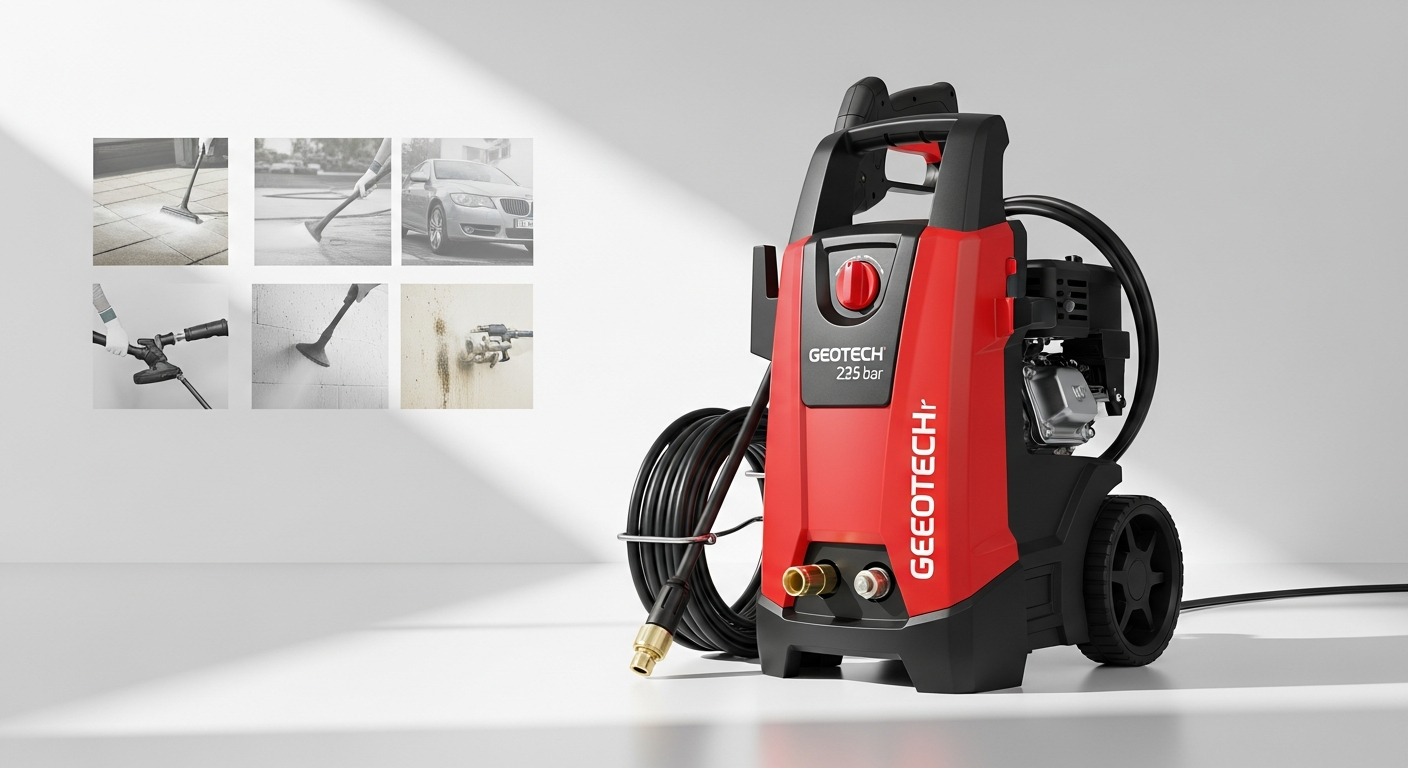
The GeoTech PWP 15/235 ZW represents a fascinating segment in the pressure washer market: semi-professional equipment that refuses to compromise on power or durability. This Benzin-Hochdruckreiniger bridges the gap between expensive professional-grade machines and underpowered consumer models with a 9 HP Loncin engine, brass-headed linear pump, and competitive pricing that makes professional-level cleaning accessible.
Engineered for Intensive Work: The Loncin G270F Powertrain
9 HP Displacement and 270 CCM Engine Capacity Explained
The heart of the PWP 15/235 ZW is the Loncin G270F 4-stroke engine, a 270 cubic centimeter displacement unit delivering 9 horsepower. This engine class occupies the sweet spot for semi-professional cleaning equipment—enough raw power to drive demanding pumps without requiring the fuel consumption or maintenance complexity of larger industrial engines. The 270 ccm displacement translates to consistent torque delivery across extended operating sessions, crucial for jobs lasting four to eight hours.
4-Stroke Petrol Engine Advantages Over 2-Stroke Alternatives
Four-stroke engines dominate semi-professional pressure washer design for good reason. Unlike their 2-stroke counterparts, 4-stroke units burn oil separately from fuel, eliminating the need to premix fuel and reducing exhaust emissions significantly. This design also produces considerably less noise—a critical advantage on residential construction projects or near neighboring properties. The Loncin engine operates at full fuel efficiency across its RPM range, translating to lower operational costs per cleaning hour compared to less efficient alternatives.
Recoil Start System Reliability and Ease of Operation
The PWP 15/235 ZW employs a recoil start mechanism rather than electronic ignition. This choice enhances reliability in outdoor, muddy, or wet environments where electrical systems prove vulnerable. Cold starts require a firm pull on the starter cord, but the Loncin’s design minimizes the number of pulls needed to achieve ignition—typically one to three pulls from a cold engine and a single pull when warm.
Fuel Efficiency Considerations for Extended Job Sites
The Loncin G270F demonstrates respectable fuel consumption for a 9 HP engine operating at 235 bar. Most users report fuel requirements ranging from 2.5 to 3.5 liters per hour at full power, depending on duty cycle and pressure regulation settings. For all-day job sites, this means budgeting approximately 20-28 liters of fuel for an eight-hour operation, manageable with standard jerry cans and reasonable cost.
Maintenance Intervals and Long-Term Engine Durability
Petrol engines require scheduled maintenance to maintain performance. The Loncin G270F needs oil changes every 50-100 operating hours—roughly every 15-25 days of regular use. Air filter inspection should occur monthly, with replacement every 200 hours. Spark plugs typically survive 500+ operating hours before degradation. The brass-headed pump design and ceramic pistons mean the high-pressure system demands less maintenance than the engine itself, though the pump should receive seasonal inspection for wear patterns.
Comparison with Electric and Diesel Alternatives for Heavy-Duty Scenarios
Electric pressure washers eliminate fuel concerns and minimize noise, but they tether operators to power sources and deliver lower sustained pressure for heavy degreasing tasks. Diesel engines offer superior fuel economy but cost substantially more upfront and complicate engine management. The petrol Loncin represents the practical compromise: lower fuel costs than comparable electric equipment, better accessibility than diesel-specific service networks, and sufficient power for genuine heavy-duty work.
Pump Technology That Separates Professionals from Amateurs
Linear Pump Design Versus Axial Pump Construction
The PWP 15/235 ZW uses a linear pump—a design where pistons move in a straight line perpendicular to the pump’s central axis. This architecture contrasts sharply with axial pump designs, where pistons move at an angle within a rotating chamber. Linear pumps require more complex manufacturing but deliver superior durability under intensive use, which explains their prevalence in professional equipment. Axial pumps suffice for light-duty residential tasks but fail prematurely under the grinding demands of construction and agricultural work.
Brass Pump Head Benefits for Corrosion Resistance
The pump head—the component containing the internal passages and sealing surfaces—is cast from brass rather than aluminum. Brass resists corrosion from high-pressure water, salt spray, and acidic cleaning chemicals far better than aluminum. This material choice directly impacts longevity; a brass pump head remains functional after years of coastal salt water exposure or repeated degreasing chemical contact, while aluminum heads degrade and lose efficiency.
Three Ceramic Pistons: Why Material Composition Matters
The three ceramic pistons within the pump represent the critical wear surfaces. Ceramic offers exceptional hardness, resisting the microscopic abrasion that occurs during thousands of compression cycles. Standard aluminum or chrome-plated steel pistons degrade faster under high-pressure operation, requiring replacement within 500-800 hours. Ceramic pistons sustain 1500+ operating hours before replacement becomes necessary—a dramatic lifespan extension that justifies the higher manufacturing cost.
235 Bar Maximum Pressure Capabilities and Real-World Applications
235 bar (approximately 3,400 PSI) sits comfortably in the professional-grade pressure range. This pressure level effectively tackles concrete degreasing, paint removal from industrial surfaces, and heavy equipment cleaning. It falls short of ultra-high-pressure equipment (400+ bar) but exceeds residential equipment (100-150 bar) by substantial margins. The pressure regulator allows operation at lower pressures for delicate surfaces, making the machine versatile across multiple cleaning scenarios.
900 Liters Per Hour Flow Rate: What It Means for Cleaning Speed
The 15 liters-per-minute (900 liters per hour) flow rate determines how quickly the machine can cover ground. This flow rate enables effective cleaning of large surface areas without excessive standing time. A construction crew cleaning 500 square meters of concrete can accomplish the task in roughly 8-10 hours with the PWP 15/235 ZW, compared to 15-20 hours with lower-flow equipment. The combination of 235 bar pressure and 15 liters per minute creates genuine work acceleration.
3600 RPM Pump Speed and Efficiency Ratings
The pump operates at 3600 revolutions per minute, directly coupled to the Loncin engine’s output shaft. This speed represents optimal efficiency for the linear pump design—fast enough to minimize energy losses but not so rapid that internal friction becomes problematic. Most users won’t notice the RPM figure directly, but it translates to the responsiveness they feel when adjusting pressure levels or switching between nozzles.
Mobility on Challenging Terrain: Trolley Design and Portability
55 KG Weight Distribution and Center of Gravity Considerations
At 55 kilograms, the PWP 15/235 ZW qualifies as a portable machine only when considering the wheeled trolley frame. The weight distribution—engine and pump centered over the axle—maintains a low center of gravity that prevents tipping during operation on slopes or uneven ground. Solo operators can maneuver the unit around job sites, though lifting it into vehicles or over obstacles demands physical capability or mechanical assistance.
Pneumatic Wheels (4.00-6) Performance on Gravel, Mud, and Uneven Surfaces
The 4.00-6 pneumatic tires (approximately 40 cm diameter) are sized specifically for industrial equipment navigation rather than road transport. These tires penetrate soft ground more effectively than smaller solid wheels, distributing pressure across muddy construction sites without sinking excessively. The pneumatic design absorbs vibration from uneven terrain, crucial for operator comfort during multi-hour sessions. However, these tires require periodic air pressure checks—typically 2.5-3.0 bar—to maintain optimal performance.
Metal Trolley Construction for Stability During Operation
The trolley frame, constructed from welded steel tubing, provides rigid support during high-pressure operation. The vibrations generated by the 9 HP engine and pump are absorbed by the frame rather than transmitted to the operator, reducing fatigue. The handle design positions the user at comfortable height while maintaining visibility of the pressure gauge and controls. Rust-resistant paint protects the frame from weather exposure, though eventual touch-ups become necessary in harsh environments.
Maneuverability in Tight Spaces and Confined Areas
The PWP 15/235 ZW measures approximately 1 meter in length and 70 centimeters in width—dimensions that permit passage through standard doorways and navigate warehouse aisles. The handle design allows one-handed steering when necessary, freeing the operator to manage the high-pressure hose. For enclosed facility cleaning—vehicle bays, industrial kitchens, indoor growing facilities—this compact footprint proves genuinely advantageous.
Lifting and Transport Challenges for Solo Operators
The 55 kg weight presents genuine challenges when loading into trucks or transporting up stairs. Most professionals use mechanical lifts or work in pairs during transport. Straps attached to the trolley frame permit dragging across flat surfaces, but overhead lifting demands either team effort or specialized equipment. Organizations frequently address this limitation by assigning the PWP 15/235 ZW to stationary job sites where transport frequency remains minimal.
Comparison with Stationary or Smaller Wheeled Models
Stationary pressure washer installations eliminate transport concerns but lock equipment to single locations. Smaller wheeled models (25-35 kg) sacrifice the powerful Loncin engine and brass-headed pump for portability, resulting in lower cleaning performance. The PWP 15/235 ZW strikes a practical balance—heavy enough for robust components, yet mobile enough for most job site requirements when planning is involved.
Real-World Applications: Where the PWP 15/235 ZW Proves Its Worth
Agricultural Equipment Cleaning and Farm Machinery Maintenance
Tractors, combines, and hay equipment accumulate caked mud, fertilizer residue, and biological buildup that invites corrosion. The 235 bar pressure and 15 liters-per-minute flow rate remove these contaminants rapidly without damaging paint or rubber seals. Agricultural operators report cleaning entire machine equipment in 6-8 hours, contrasted with 20+ hours using lower-pressure alternatives. The Loncin engine’s fuel efficiency makes extended operation affordable for seasonal farm cleaning cycles.
Construction Site Surface Preparation and Concrete Degreasing
Construction sites generate concrete surfaces contaminated with hydraulic fluid, engine oil, and curing compounds. Professional contractors employ the PWP 15/235 ZW during concrete surface prep before applying epoxy or sealant coatings. The combination of pressure and flow rate removes surface contaminants while maintaining concrete integrity. Time savings translate directly to project margin improvements—completing concrete prep one day ahead of schedule on a multi-million-euro facility justifies the equipment investment.
Industrial Facility Maintenance and Heavy-Duty Decontamination
Manufacturing facilities, chemical plants, and logistics warehouses require periodic deep cleaning of floors, equipment exteriors, and loading areas. The PWP 15/235 ZW handles these industrial demands without the enterprise pricing of dedicated facility systems. Facility managers appreciate the portability—the machine can address localized contamination without scheduling downtime for centralized cleaning systems.
Forestry and Outdoor Equipment Restoration
Forestry equipment, sawmill machinery, and outdoor power tools benefit from thorough pressure washing that removes bark, sap, and accumulated debris. The 235 bar pressure dislodges stubborn material while the operator controls flow to avoid component damage. Forestry contractors frequently maintain PWP 15/235 ZW units at remote work sites where equipment cleanliness directly impacts operational efficiency.
Vehicle and Fleet Washing Operations
Commercial vehicle fleets—delivery trucks, construction vehicles, agricultural equipment—require periodic deep cleaning. The PWP 15/235 ZW handles undercarriage mud removal, engine bay degreasing, and exterior surface washing at rates substantially faster than garden hose alternatives. Fleet operators calculate washing costs per vehicle and find the semi-professional equipment significantly reduces labor hours.
Facade and Exterior Building Cleaning Projects
Building facades accumulate algae, mold, and weathering that diminishes aesthetic appeal. The PWP 15/235 ZW removes these contaminants from brick, concrete, and textured surfaces. Pressure regulation permits adjustment for delicate surfaces—lower pressure for painted wood, higher pressure for concrete. Property management companies frequently employ the equipment for seasonal building maintenance.
Dock and Warehouse Surface Treatment
Loading docks experience heavy traffic from wheeled equipment, generating oil stains and accumulated grime. The PWP 15/235 ZW restores dock surfaces to safe, slip-resistant conditions. Warehouse floors respond well to the pressure washer treatment, removing dust buildup that complicates inventory management and creates fire hazards in certain industrial settings.
The Complete Package: Accessories and System Integration
10-Meter High-Pressure Hose Specifications and Durability
The supplied 10-meter high-pressure hose permits operation from that distance from the water source, adequate for most job site requirements. The hose features reinforced construction rated for the PWP 15/235 ZW’s full 235 bar output. Users report hose longevity exceeding 300-400 operating hours before requiring replacement due to normal wear. The standard connection system remains compatible with common replacement hoses, permitting cost-effective length extension.
Pressure Regulator Functionality and Adjustment Ranges
The integrated pressure regulator permits operation anywhere from 50 bar to the full 235 bar maximum. This flexibility enables the same machine to wash delicate surfaces—vehicle paint requiring 100 bar, wooden decks requiring 80 bar—and heavy industrial surfaces requiring full pressure. The regulator responds smoothly to adjustment, enabling operators to fine-tune pressure within seconds.
Included Accessories and Typical Free Additions from AgriEuro
The basic package typically includes the high-pressure hose, standard nozzle assortment, and engine oil for initial operation. AgriEuro frequently includes bonus accessories such as additional nozzles, detergent bottles, or spare spark plugs with purchases, reducing out-of-pocket investment required for immediate operation.
Compatible Nozzle Options for Different Cleaning Tasks
Standard nozzles span pressures from 0 degrees (full-jet, maximum cleaning power) through 40 degrees (wide spray, safer for delicate surfaces). Detergent injection nozzles permit chemical application for enhanced cleaning of particularly stubborn contamination. Specialty nozzles—gutter cleaning, underbody wash—expand the equipment’s utility beyond basic high-pressure washing.
Extension Hose Requirements for Larger Jobs
Ten meters limits operators to job sites within that radius of water sources. Agricultural facilities and large construction sites often require 20-30 meter operating distances. Extension hoses—available in 10 or 20 meter increments—couple to the supplied hose, expanding reach. Each additional hose section increases system weight and requires periodic inspection for leaks at connection points.
Detergent Injection Capabilities and Chemical Compatibility
The PWP 15/235 ZW accommodates detergent injection through the supply line, permitting application of cleaning chemicals without disrupting the machine’s pressure output. This feature proves invaluable for degreasing, algae removal, and industrial contamination remediation. The system’s brass components resist corrosion from alkaline and acidic cleaning agents, permitting broad chemical compatibility.
Balancing Power Against Operational Realities
Noise Levels and Hearing Protection Requirements
The Loncin G270F produces approximately 95-100 decibels at full power—comparable to construction site noise but louder than residential lawn equipment. Operators require hearing protection (ear plugs or muffs rated for 85+ dB) during extended use. The noise level restricts operation in sound-sensitive environments—early morning residential areas, hospitals, or educational facilities require noise variance approvals.
Exhaust Emissions and Environmental Considerations
Petrol engines emit nitrogen oxides and particulate matter, minimal by modern standards due to the 4-stroke design but present nonetheless. Operations in enclosed spaces require adequate ventilation. Organizations operating in emissions-restricted regions should verify compliance with local air quality standards before purchasing petrol equipment.
Fuel Consumption Rates for Budgeting Job Costs
Operating costs depend on fuel pricing and duty cycle. At 2.5-3.5 liters per hour and typical regional fuel pricing of €1.50-1.80 per liter, fuel expenses range from €3.75-6.30 per operating hour. Over a 250-hour annual operating cycle, fuel costs total €937-1,575, a manageable expense for professional equipment generating billable work.
Vibration and Operator Fatigue During Extended Use
The 55 kg machine and high-pressure pump generate vibration transmitted through the high-pressure hose to the operator’s hands. Extended operation—8+ hours daily—can result in vibration-related fatigue. Most professional operators limit daily exposure to 4-6 hours, using team rotation to complete larger jobs. Vibration dampening hose attachments reduce transmission to hands, available as aftermarket upgrades.
Weather Limitations and Seasonal Operation Planning
Freezing temperatures threaten petrol engines due to water contamination and fuel thickening. Winter storage requires fuel stabilization and engine winterization procedures. Summer operation proves unaffected by temperature extremes, though operator fatigue increases in high heat environments. Most agricultural and construction operations employ seasonal use patterns, hibernating equipment during winter months.
Storage and Winterization Procedures for Petrol Engines
Extended off-season storage demands specific procedures. The fuel tank should be emptied or treated with stabilizer to prevent gum formation. Engine oil should be checked and topped if necessary. The recoil starter requires a gentle pull every few weeks to prevent internal corrosion. Proper preparation ensures trouble-free starts when seasonal operation resumes.
Investment Analysis: Value Proposition at €420
Price Positioning Against Comparable Semi-Professional Models
The €420 price point (excluding VAT) positions the PWP 15/235 ZW competitively against comparable semi-professional equipment. German-manufactured competitors typically price similarly equipped models at €450-550, while lower-quality imported alternatives list at €300-380 but sacrifice pump durability and engine reliability. The GeoTech represents genuine value for organizations prioritizing long-term performance.
Cost-Per-Bar and Cost-Per-Liter-Per-Minute Calculations
Cost-per-bar metrics calculate initial investment divided by pressure output: €420 ÷ 235 bar = €1.79 per bar. Cost-per-liter-per-minute calculations divide price by flow rate: €420 ÷ 15 liters per minute = €28 per liter-per-minute capacity. Both metrics position the PWP 15/235 ZW favorably against professional-grade equipment costing €900-1,500, which often deliver marginally superior performance but consume 2-3 times more capital investment.
ROI Timeline for Trade Professionals and Contractors
Professional contractors generating €50-80 per hour in billable pressure washing work achieve equipment payback within 6-8 operating hours. For organizations where pressure washing comprises one maintenance function among many, ROI stretches across a full operational season—12-24 months—as the machine reduces outsourced cleaning costs. Agricultural operators purchasing for seasonal annual use achieve multi-year payback, with the equipment lasting 5+ years before major component replacement.
Warranty Coverage and After-Sales Support from AgriEuro
AgriEuro provides standard warranty coverage for manufacturing defects, typically 12-24 months depending on component type. The retailer maintains European warranty service centers, enabling expedited repairs rather than factory shipping delays. This local support infrastructure meaningfully enhances the ownership experience, particularly compared to importing directly from distant manufacturers.
Spare Parts Availability and Service Center Network
Loncin engines are manufactured worldwide with established aftermarket supply chains. The linear pump components—pistons, gaskets, seals—are stocked by AgriEuro and authorized service partners throughout Europe. A PWP 15/235 ZW operator can typically source replacement parts within 3-5 business days, avoiding extended downtime that would accompany equipment requiring specialized import sourcing.
Resale Value and Long-Term Ownership Costs
Semi-professional pressure washers retain approximately 50-60% of initial purchase price after 3-4 years of ownership, provided they receive adequate maintenance. The brass-headed pump and ceramic pistons reputation creates secondary market demand from operators seeking used equipment as cost-effective entry points. Expected ownership cost, including fuel, occasional maintenance, and depreciation, calculates to approximately €150-200 annually for operations using the equipment 250+ hours yearly.
Operator Experience: Who Should Choose This Machine
Ideal User Profiles: Contractors, Farmers, Facility Managers
Contractors tackling concrete prep, surface cleaning, and equipment degreasing benefit immediately from the PWP 15/235 ZW’s combination of power and portability. Agricultural operators managing seasonal equipment cleaning find the Loncin engine’s fuel efficiency and durability ideal for intermittent heavy-duty work. Facility managers at warehouses, manufacturing plants, and logistics centers appreciate the equipment’s ability to handle periodic deep cleaning without capital investment in fixed infrastructure.
Skill Level Requirements and Learning Curve
Operating the PWP 15/235 ZW requires basic mechanical competency: ability to start a petrol engine, connect hose fittings, and adjust pressure settings. First-time users typically require 15-30 minutes of instruction before independent operation. The learning curve extends slightly if detergent injection or specialty nozzles are employed, but core operation remains accessible to operators without technical background.
Physical Capability Considerations and Operator Safety
The 55 kg weight and 9 HP engine vibration demand reasonable physical capability. Operators managing lifting during transport should be comfortable with 55 kg loads or employ team assistance. The high-pressure hose generates reaction force during operation—maintaining control with a full 235 bar jet requires firm grip strength and body positioning. Most operators can safely manage operation, but those with limited strength or mobility should evaluate lower-pressure alternatives.
Frequency of Use and Duty Cycle Recommendations
The PWP 15/235 ZW performs optimally in intermittent duty cycles: 20-30 hours monthly or 200-300 hours annually. The engine and pump sustain this workload indefinitely with scheduled maintenance. Organizations operating the equipment continuously—40+ hours weekly—should consider multiple units for rotation, allowing individual machines routine service and preventing excessive component wear.
Team Versus Solo Operation Scenarios
Solo operators can manage the PWP 15/235 ZW for most tasks, controlling the high-pressure hose while monitoring engine and pump operation. Larger jobs benefit from team deployment: one operator managing the pressure washer controls while a second directs the high-pressure stream across surfaces. Team operation accelerates completion and reduces individual operator fatigue.
Training and Best Practice Recommendations
AgriEuro provides basic operating instructions with each machine. Organizations should supplement this with practical training covering pressure adjustment for different surfaces, detergent application procedures, and seasonal maintenance schedules. Professional contractors often develop site-specific training addressing water sourcing, hose routing, and safety protocols relevant to their particular applications.
Making the Right Choice for Your Cleaning Arsenal
The GeoTech PWP 15/235 ZW Benzin-Hochdruckreiniger occupies a strategic position in the pressure washer landscape. You’re acquiring genuine professional-grade components—a brass-headed linear pump with ceramic pistons, a robust Loncin engine, and 235 bar of sustained pressure—without the enterprise-level price tag that typically accompanies such specifications. The wheeled trolley design and 15 liters-per-minute flow rate make it genuinely mobile and capable of handling demanding jobs that would frustrate lighter equipment.
That said, the 55 kg weight and petrol engine characteristics demand honest consideration. If you operate in noise-sensitive areas, require electric power, or struggle with equipment maintenance, this machine presents real trade-offs. But for agricultural operators, construction professionals, and serious hobbyists tackling concrete, degreasing, and industrial cleaning—this unit delivers tangible performance gains that justify its investment. AgriEuro’s support infrastructure, including accessible spare parts and specialized service centers, transforms this from a one-time purchase into a long-term asset.
I’d recommend evaluating your specific cleaning demands, frequency of use, and operational environment before deciding. If heavy-duty petrol-powered cleaning aligns with your work profile, the PWP 15/235 ZW deserves serious consideration.